
Stock photo: cover may vary
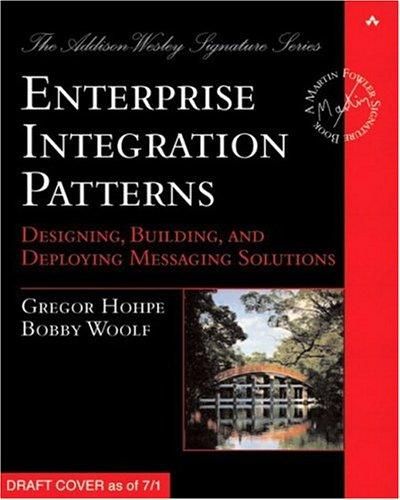
Enterprise Integration Patterns: Designing, Building, and Deploying Messaging Solutions (Addison-Wesley Signature Series (Fowler)) Hardback - 2003 - 1st Edition
by Hohpe, Gregor
- Used
- Good
- Hardback
A$63.59
Free Delivery within USA
Standard delivery: 7 to 14 days
More delivery options
Standard delivery: 7 to 14 days
Dropship order
Ships from Bonita (California, United States)
Details
- Title Enterprise Integration Patterns: Designing, Building, and Deploying Messaging Solutions (Addison-Wesley Signature Series (Fowler))
- Author Hohpe, Gregor
- Binding Hardback
- Edition number 1st
- Edition 1
- Condition Used - Good
- Pages 736
- Volumes 1
- Language ENG
- Publisher Addison-Wesley Professional, Boston, MA, U.S.A.
- Publication date 2003-10-10
- Features Bibliography, Index
- Bookseller's Inventory # 0321200683.G
- ISBN 9780321200686 / 0321200683
- Weight 2.95 lbs (1.34 kg)
- Dimensions 9.4 x 7.2 x 1.7 in (23.88 x 18.29 x 4.32 cm)
- Category Computers - Languages / Programming
- Library of Congress subjects Management information systems, Telecommunication - Message processing
- Library of Congress Catalogue Number 2003017989
- Dewey Decimal Code 005.713
- Quantity available 1
About Bonita California, United States
Reader reviews for Enterprise Integration Patterns: Designing, Building, and Deploying Messaging Solutions (Addison-Wesley Signature Series (Fowler))
Write a review for this book
Important Terms and Guidelines
- Please focus on the book’s content and context. Also, add any personal comments as to how you enjoyed the book. Substantiate your likes and dislikes. You may make comparisons to other books.
- Reviews must be at least 140 characters in length.
- Please do not reveal critical plot elements.
- This is not a help line. Contact customer support if you need help.
Your review must not include:
- Obscenities, discriminatory language, or other insulting language not suitable for public domain
- Advertisements, “spam” content, or references to other products, offers or websites.
- Email addresses, URLs, phone numbers, physical addresses or other contact information.
- Overly critical comments about other reviews or reviewers
- Time-sensitive material (i.e. promotional tours, seminars, lectures, etc.)
- Availability, price, or alternative ordering/shipping information
From the publisher
From the rear cover
Utilizing years of practical experience, seasoned experts Gregor Hohpe and Bobby Woolf show how asynchronous messaging has proven to be the best strategy for enterprise integration success. However, building and deploying messaging solutions presents a number of problems for developers. Enterprise Integration Patterns provides an invaluable catalog of sixty-five patterns, with real-world solutions that demonstrate the formidable of messaging and help you to design effective messaging solutions for your enterprise.
The authors also include examples covering a variety of different integration technologies, such as JMS, MSMQ, TIBCO ActiveEnterprise, Microsoft BizTalk, SOAP, and XSL. A case study describing a bond trading system illustrates the patterns in practice, and the book offers a look at emerging standards, as well as insights into what the future of enterprise integration might hold.
This book provides a consistent vocabulary and visual notation framework to describe large-scale integration solutions across many technologies. It also explores in detail the advantages and limitations of asynchronous messaging architectures. The authors present practical advice on designing code that connects an application to a messaging system, and provide extensive information to help you determine when to send a message, how to route it to the proper destination, and how to monitor the health of a messaging system. If you want to know how to manage, monitor, and maintain a messaging system once it is in use, get this book.
0321200683B09122003
