
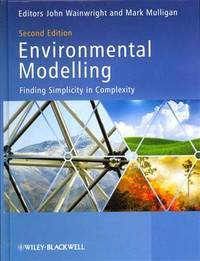
Stock photo: cover may vary
ENVIRONMENTAL MODELLING: FINDING SIMPLICITY IN COMPLEXITY, 2 EDITION HB (2013) Hardback - 2013 - 2nd Edition
by WAINWRIGHT
- New
A$153.76
A$21.27
Delivery to USA
Standard delivery: 7 to 14 days
More delivery options
Standard delivery: 7 to 14 days
Details
- Title ENVIRONMENTAL MODELLING: FINDING SIMPLICITY IN COMPLEXITY, 2 EDITION HB (2013)
- Author WAINWRIGHT
- Binding Hardback
- Edition number 2nd
- Edition 2
- Condition New
- Pages 496
- Volumes 1
- Language ENG
- Publisher Wiley, Hoboken NJ
- Publication date 2013-03-08
- Features Bibliography, Index, Maps, Table of Contents, Textbook
- Bookseller's Inventory # BIBNN-54561
- ISBN 9780470749111 / 0470749113
- Weight 2.2 lbs (1.00 kg)
- Dimensions 9.8 x 7.6 x 1.1 in (24.89 x 19.30 x 2.79 cm)
- Category Technology & Industrial Arts
- Library of Congress subjects Environmental sciences - Mathematical models
- Library of Congress Catalogue Number 2012017568
- Dewey Decimal Code 628
- Quantity available 5
About Students Textbooks India
Specialising in: International Edition., Textbooks
Biblio member since 2009
Selling textbooks, International editions and reference books online from last 5 Years.
30 day return guarantee, with full refund including shipping costs for up to 30 days after delivery if an item arrives misdescribed or damaged. Return address: Students_Textbooks 12 phankha road Jankpuri New Delhi 110036 India
Reader reviews for ENVIRONMENTAL MODELLING: FINDING SIMPLICITY IN COMPLEXITY, 2 EDITION HB (2013)
Write a review for this book
Important Terms and Guidelines
- Please focus on the book’s content and context. Also, add any personal comments as to how you enjoyed the book. Substantiate your likes and dislikes. You may make comparisons to other books.
- Reviews must be at least 140 characters in length.
- Please do not reveal critical plot elements.
- This is not a help line. Contact customer support if you need help.
Your review must not include:
- Obscenities, discriminatory language, or other insulting language not suitable for public domain
- Advertisements, “spam” content, or references to other products, offers or websites.
- Email addresses, URLs, phone numbers, physical addresses or other contact information.
- Overly critical comments about other reviews or reviewers
- Time-sensitive material (i.e. promotional tours, seminars, lectures, etc.)
- Availability, price, or alternative ordering/shipping information
From the publisher
From the rear cover
Second Edition Environmental Modelling Finding Simplicity in Complexity
Simulation models are an established method used to investigate processes and solve practical problems in a wide variety of disciplines. Central to the concept of this second edition is the idea that environmental systems are complex, open systems. The authors present the diversity of approaches to dealing with environmental complexity and then encourage readers to make comparisons between these approaches and between different disciplines.
Environmental Modelling: Finding Simplicity in Complexity, Second Edition, is divided into four main sections:
1. An overview of methods and approaches to modelling. 2. State of the art for modelling environmental processes. 3. Tools used and models for management. 4. Current and future developments.
The second edition evolves from the first by providing additional emphasis and material for those students wishing to specialize in environmental modelling.
This book is suitable for final year undergraduates and postgraduates in environmental modelling, environmental science, civil engineering and biology who will already be familiar with the subject and are moving on to specialize in the field. It is also designed to appeal to professionals interested in the environmental sciences, including environmental consultants, government employees, civil engineers, geographers, ecologists, meteorologists, and geochemists.
This second edition:
- Focuses on simplifying complex environmental systems.
- Reviews current software, tools and techniques for modelling.
- Gives practical examples from a wide variety of disciplines, e.g. climatology, ecology, hydrology, geomorphology and engineering.
- Has an associated website containing colour images, links to WWW resources and chapter support pages, including data sets relating to case studies, exercises and model animations.
Media reviews
Citations
- Choice, 01/01/2014, Page 0

