
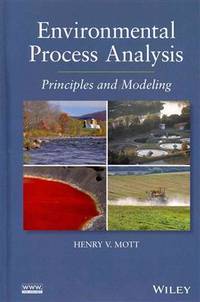
Stock photo: cover may vary
Environmental Process Analysis: Principles and Modeling Hardback - 2013
by Mott, Henry V
- New
- Hardback
- first
A$327.15
Free Delivery within USA
Standard delivery: 5 to 10 days
More delivery options
Standard delivery: 5 to 10 days
Dropship order
Ships from Ergodebooks (Texas, United States)
Details
- Title Environmental Process Analysis: Principles and Modeling
- Author Mott, Henry V
- Binding Hardback
- Edition 1
- Condition New
- Pages 640
- Volumes 1
- Language ENG
- Publisher Wiley
- Publication date 2013-12-09
- Features Bibliography, Index, Table of Contents
- Bookseller's Inventory # DADAX1118115015
- ISBN 9781118115015 / 1118115015
- Weight 2.2 lbs (1.00 kg)
- Dimensions 9.3 x 6.3 x 1.4 in (23.62 x 16.00 x 3.56 cm)
- Size 6.30x1.50x9.40
-
Themes
- Topical: Ecology
- Category Science
- Library of Congress subjects Environmental chemistry, Chemical processes
- Library of Congress Catalogue Number 2013016208
- Dewey Decimal Code 577.14
- Quantity available 6
About Ergodebooks Texas, United States
Biblio member since 2005
Our goal is to provide best customer service and good condition books for the lowest possible price. We are always honest about condition of book. We list book only by ISBN # and hence exact book is guaranteed.
We have 30 day return policy.
Reader reviews for Environmental Process Analysis: Principles and Modeling
Write a review for this book
Important Terms and Guidelines
- Please focus on the book’s content and context. Also, add any personal comments as to how you enjoyed the book. Substantiate your likes and dislikes. You may make comparisons to other books.
- Reviews must be at least 140 characters in length.
- Please do not reveal critical plot elements.
- This is not a help line. Contact customer support if you need help.
Your review must not include:
- Obscenities, discriminatory language, or other insulting language not suitable for public domain
- Advertisements, “spam” content, or references to other products, offers or websites.
- Email addresses, URLs, phone numbers, physical addresses or other contact information.
- Overly critical comments about other reviews or reviewers
- Time-sensitive material (i.e. promotional tours, seminars, lectures, etc.)
- Availability, price, or alternative ordering/shipping information
From the rear cover
Enables readers to apply core principles of environmental engineering to analyze environmental systems
Environmental Process Analysis takes a unique approach, applying mathematical and numerical process modeling within the context of both natural and engineered environmental systems. Readers master core principles of natural and engineering science such as chemical equilibria, reaction kinetics, ideal and non-ideal reactor theory, and mass accounting by performing practical real-world analyses. As they progress through the text, readers will have the opportunity to analyze a broad range of environmental processes and systems, including water and wastewater treatment, surface mining, agriculture, landfills, subsurface saturated and unsaturated porous media, aqueous and marine sediments, surface waters, and atmospheric moisture.
The text begins with an examination of water, core definitions, and a review of important chemical principles. It then progressively builds upon this base with applications of Henry's law, acid/base equilibria, and reactions in ideal reactors. Finally, the text addresses reactions in non-ideal reactors and advanced applications of acid/base equilibria, complexation and solubility/dissolution equilibria, and oxidation/reduction equilibria.
Several tools are provided to fully engage readers in mastering new concepts and then applying them in practice, including:
- Detailed examples that demonstrate the application of concepts and principles
- Problems at the end of each chapter challenging readers to apply their newfound knowledge to analyze environmental processes and systems
- MathCAD worksheets that provide a powerful platform for constructing process models
Environmental Process Analysis serves as a bridge between introductory environmental engineering textbooks and hands-on environmental engineering practice. By learning how to mathematically and numerically model environmental processes and systems, readers will also come to better understand the underlying connections among the various models, concepts, and systems.

