
Stock photo: cover may vary
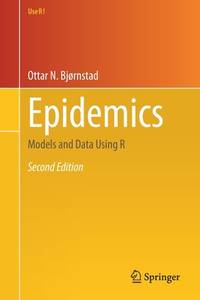
Epidemics: Models and Data Using R (Use R!)
by Bj�rnstad, Ottar N
- New
A$232.18
A$6.46
Delivery within USA
Standard delivery: 5 to 10 days
More delivery options
Standard delivery: 5 to 10 days
Ships from XLANCEBOOKS L.L.C. (Wyoming, United States)
Details
- Title Epidemics: Models and Data Using R (Use R!)
- Author Bj�rnstad, Ottar N
- Edition USA Edition
- Condition New
- Features Illustrated
- Bookseller's Inventory # AD 9783031120558
- ISBN 9783031120558
- Quantity available 3
About XLANCEBOOKS L.L.C. Wyoming, United States
Reader reviews for Epidemics: Models and Data Using R (Use R!)
Write a review for this book
Important Terms and Guidelines
- Please focus on the book’s content and context. Also, add any personal comments as to how you enjoyed the book. Substantiate your likes and dislikes. You may make comparisons to other books.
- Reviews must be at least 140 characters in length.
- Please do not reveal critical plot elements.
- This is not a help line. Contact customer support if you need help.
Your review must not include:
- Obscenities, discriminatory language, or other insulting language not suitable for public domain
- Advertisements, “spam” content, or references to other products, offers or websites.
- Email addresses, URLs, phone numbers, physical addresses or other contact information.
- Overly critical comments about other reviews or reviewers
- Time-sensitive material (i.e. promotional tours, seminars, lectures, etc.)
- Availability, price, or alternative ordering/shipping information
From the publisher
From the rear cover
This book is designed to be a practical study in infectious disease dynamics. It offers an easy-to-follow implementation and analysis of mathematical epidemiology. It focuses on recent case studies in order to explore various conceptual, mathematical, and statistical issues. The dynamics of infectious diseases shows a wide diversity of pattern. Some have locally persistent chains-of-transmission, others persist spatially in consumer-resource metapopulations. Some infections are prevalent among the young, some among the old and some are age-invariant. Temporally, some diseases have little variation in prevalence, some have predictable seasonal shifts and others exhibit violent epidemics that may be regular or irregular in their timing. Models and 'models-with-data' have proved invaluable for understanding and predicting this diversity, and thence help improve intervention and control. Using mathematical models to understand infectious disease, dynamicshas a very rich history in epidemiology. The field has seen broad expansions of theories as well as a surge in real-life application of mathematics to dynamics and control of infectious disease. The chapters of Epidemics: Models and Data Using R have been organized as follows: chapters 1-10 is a mix and match of models, data and statistics pertaining to local disease dynamics; chapters 11-13 pertains to spatial and spatiotemporal dynamics; chapter 14 highlights similarities between the dynamics of infectious disease and parasitoid-host dynamics; Finally, chapters 15 and 16 overview additional statistical methodology useful in studies of infectious disease dynamics.
This book can be used as a guide for working with data, models and 'models-and-data' to understand epidemics and infectious disease dynamics in space and time. All the code and data sets are distributed in the epimdr2 R package to facilitate the hands-on philosophy of the text.
This book can be used as a guide for working with data, models and 'models-and-data' to understand epidemics and infectious disease dynamics in space and time. All the code and data sets are distributed in the epimdr2 R package to facilitate the hands-on philosophy of the text.

