
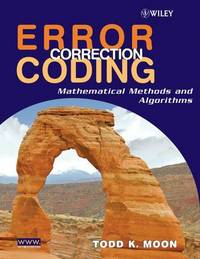
Stock photo: cover may vary
Error Correction Coding : Mathematical Methods and Algorithms Hardback - 2005
by Moon, Todd K
- Used
A$237.92
Free Delivery within USA
Standard delivery: 4 to 8 days
More delivery options
Standard delivery: 4 to 8 days
Details
- Title Error Correction Coding : Mathematical Methods and Algorithms
- Author Moon, Todd K
- Binding Hardback
- Edition INTERNATIONAL ED
- Condition Used - Good
- Pages 800
- Volumes 1
- Language ENG
- Publisher Wiley & Sons, Incorporated, John, Hoboken
- Publication date June 6, 2005
- Bookseller's Inventory # 8972543-6
- ISBN 9780471648000 / 0471648000
- Weight 3.36 lbs (1.52 kg)
- Dimensions 9.7 x 7.68 x 1.66 in (24.64 x 19.51 x 4.22 cm)
- Category Technology & Industrial Arts
- Library of Congress subjects Engineering mathematics, Error-correcting codes (Information theory)
- Library of Congress Catalogue Number 2004031019
- Dewey Decimal Code 621.382
- Quantity available 1
About Better World Books Indiana, United States
Biblio member since 2005

Better World Books is a for-profit, socially conscious business and a global online bookseller that collects and sells new and used books online, matching each purchase with a book donation. Each sale generates funds for literacy and education initiatives in the U.S., the UK, and around the world. Since its launch in 2003, Better World Books has raised over $35 million for libraries and literacy, donated over 38 million books, and reused or recycled more than 475 million books.
Summary
An unparalleled learning tool and guide to error correction coding Error correction coding techniques allow the detection and correction of errors occurring during the transmission of data in digital communication systems. These techniques are nearly universally employed in modern communication systems, and are thus an important component of the modern information economy. Error Correction Coding: Mathematical Methods and Algorithms provides a comprehensive introduction to both the theoretical and practical aspects of error correction coding, with a presentation suitable for a wide variety of audiences, including graduate students in electrical engineering, mathematics, or computer science. The pedagogy is arranged so that the mathematical concepts are presented incrementally, followed immediately by applications to coding. A large number of exercises expand and deepen students' understanding. A unique feature of the book is a set of programming laboratories, supplemented with over 250 programs and functions on an associated Web site, which provides hands-on experience and a better understanding of the material. These laboratories lead students through the implementation and evaluation of Hamming codes, CRC codes, BCH and R-S codes, convolutional codes, turbo codes, and LDPC codes. This text offers both "classical" coding theory-such as Hamming, BCH, Reed-Solomon, Reed-Muller, and convolutional codes-as well as modern codes and decoding methods, including turbo codes, LDPC codes, repeat-accumulate codes, space time codes, factor graphs, soft-decision decoding, Guruswami-Sudan decoding, EXIT charts, and iterative decoding. Theoretical complements on performance and bounds are presented. Coding is also put into its communications and information theoretic context and connections are drawn to public key cryptosystems. Ideal as a classroom resource and a professional reference, this thorough guide will benefit electrical and computer engineers, mathematicians, students, researchers, and scientists. An Instructor's Manual presenting detailed solutions to all the problems in the book is available from the Wiley editorial department.
Reader reviews for Error Correction Coding : Mathematical Methods and Algorithms
Write a review for this book
Important Terms and Guidelines
- Please focus on the book’s content and context. Also, add any personal comments as to how you enjoyed the book. Substantiate your likes and dislikes. You may make comparisons to other books.
- Reviews must be at least 140 characters in length.
- Please do not reveal critical plot elements.
- This is not a help line. Contact customer support if you need help.
Your review must not include:
- Obscenities, discriminatory language, or other insulting language not suitable for public domain
- Advertisements, “spam” content, or references to other products, offers or websites.
- Email addresses, URLs, phone numbers, physical addresses or other contact information.
- Overly critical comments about other reviews or reviewers
- Time-sensitive material (i.e. promotional tours, seminars, lectures, etc.)
- Availability, price, or alternative ordering/shipping information
From the publisher
First line
HASH(0x11148ee0)

