
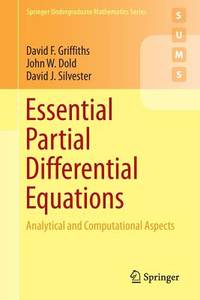
Stock photo: cover may vary
Essential Partial Differential Equations: Analytical and Computational Aspects (Springer Undergraduate Mathematics Series) Paperback - 2015
by Griffiths, David F
- New
A$156.75
A$5.64
Delivery within USA
Standard delivery: 2 to 14 days
More delivery options
Standard delivery: 2 to 14 days
Ships from GreatBookPrices (Maryland, United States)
Details
- Title Essential Partial Differential Equations: Analytical and Computational Aspects (Springer Undergraduate Mathematics Series)
- Author Griffiths, David F
- Binding Paperback
- Edition Paperback
- Condition New
- Pages 368
- Volumes 1
- Language ENG
- Publisher Springer
- Publication date 2015-10-05
- Illustrated Yes
- Features Illustrated
- Bookseller's Inventory # 24207942-n
- ISBN 9783319225685 / 3319225685
- Weight 1.18 lbs (0.54 kg)
- Dimensions 9.21 x 6.14 x 0.79 in (23.39 x 15.60 x 2.01 cm)
- Category Mathematics
- Dewey Decimal Code 515.353
- Quantity available 1
About GreatBookPrices Maryland, United States
Biblio member since 2024
Since 1991, we have worked every day to serve our customers with state-of-the-art technology and world class service. We are dedicated to providing customers around the world with the widest selection of books, DVDs, and CDs at the absolute lowest price.
Reader reviews for Essential Partial Differential Equations: Analytical and Computational Aspects (Springer Undergraduate Mathematics Series)
Write a review for this book
Important Terms and Guidelines
- Please focus on the book’s content and context. Also, add any personal comments as to how you enjoyed the book. Substantiate your likes and dislikes. You may make comparisons to other books.
- Reviews must be at least 140 characters in length.
- Please do not reveal critical plot elements.
- This is not a help line. Contact customer support if you need help.
Your review must not include:
- Obscenities, discriminatory language, or other insulting language not suitable for public domain
- Advertisements, “spam” content, or references to other products, offers or websites.
- Email addresses, URLs, phone numbers, physical addresses or other contact information.
- Overly critical comments about other reviews or reviewers
- Time-sensitive material (i.e. promotional tours, seminars, lectures, etc.)
- Availability, price, or alternative ordering/shipping information
From the publisher
From the rear cover
This volume provides an introduction to the analytical and numerical aspects of partial differential equations (PDEs). It unifies an analytical and computational approach for these; the qualitative behaviour of solutions being established using classical concepts: maximum principles and energy methods.
Notable inclusions are the treatment of irregularly shaped boundaries, polar coordinates and the use of flux-limiters when approximating hyperbolic conservation laws. The numerical analysis of difference schemes is rigorously developed using discrete maximum principles and discrete Fourier analysis. A novel feature is the inclusion of a chapter containing projects, intended for either individual or group study, that cover a range of topics such as parabolic smoothing, travelling waves, isospectral matrices, and the approximation of multidimensional advection-diffusion problems. The underlying theory is illustrated by numerous examples and there are around 300exercises, designed to promote and test understanding. They are starred according to level of difficulty. Solutions to odd-numbered exercises are available to all readers while even-numbered solutions are available to authorised instructors. Written in an informal yet rigorous style, Essential Partial Differential Equations is designed for mathematics undergraduates in their final or penultimate year of university study, but will be equally useful for students following other scientific and engineering disciplines in which PDEs are of practical importance. The only prerequisite is a familiarity with the basic concepts of calculus and linear algebra.Media reviews
Citations
- Choice, 07/01/2016, Page 0

