
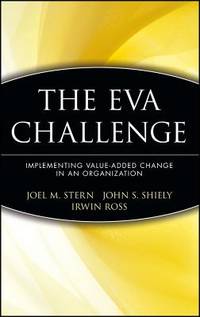
Stock photo: cover may vary
The EVA Challenge : Implementing Value-Added Change in an Organization Hardback - 2001
by Shiely, John S., Ross, Irwin, Stern, Joel M
- Used
EVA--economic valued added--is a measure of the true financial performance of a company and a strategy for creating corporate and shareholder wealth. This detailed "how-to" guide represents the second phase in the "EVA Revolution", showing executives around the world how to customize and implement EVA at their companies.
A$10.04
A$9.93
Delivery to USA
Standard delivery: 5 to 21 days
More delivery options
Standard delivery: 5 to 21 days
Details
- Title The EVA Challenge : Implementing Value-Added Change in an Organization
- Author Shiely, John S., Ross, Irwin, Stern, Joel M
- Binding Hardback
- Edition First Edition
- Condition Used - Very good
- Pages 256
- Volumes 1
- Language ENG
- Publisher Wiley & Sons, Incorporated, John, Somerset, New Jersey, U.S.A.
- Publication date February 2, 2001
- Illustrated Yes
- Features Bibliography, Illustrated, Index
- Bookseller's Inventory # GRP61759002
- ISBN 9780471405559 / 0471405558
- Weight 1.16 lbs (0.53 kg)
- Dimensions 8.78 x 6.86 x 0.94 in (22.30 x 17.42 x 2.39 cm)
- Category Business / Economics / Finance
- Library of Congress subjects Economic value added
- Library of Congress Catalogue Number 00047993
- Dewey Decimal Code 658.403
- Quantity available 1
About Better World Books Ltd Fife, United Kingdom
Biblio member since 2009
Better World Books is a for-profit, socially conscious business and a global online bookseller that collects and sells new and used books online, matching each purchase with a book donation. Each sale generates funds for literacy and education initiatives in the U.S., the U.K., and around the world. Since its launch in 2003, Better World Books has raised over $35 million for libraries and literacy, donated over 38 million books, and reused or recycled more than 475 million books.
Reader reviews for The EVA Challenge : Implementing Value-Added Change in an Organization
Write a review for this book
Important Terms and Guidelines
- Please focus on the book’s content and context. Also, add any personal comments as to how you enjoyed the book. Substantiate your likes and dislikes. You may make comparisons to other books.
- Reviews must be at least 140 characters in length.
- Please do not reveal critical plot elements.
- This is not a help line. Contact customer support if you need help.
Your review must not include:
- Obscenities, discriminatory language, or other insulting language not suitable for public domain
- Advertisements, “spam” content, or references to other products, offers or websites.
- Email addresses, URLs, phone numbers, physical addresses or other contact information.
- Overly critical comments about other reviews or reviewers
- Time-sensitive material (i.e. promotional tours, seminars, lectures, etc.)
- Availability, price, or alternative ordering/shipping information
From the publisher
First line
Back in the early 1960s, one of the authors of this volume was asked by an old family friend what he was studying at the University of Chicago.
From the jacket flap
-Economic Value Added-is a measure of the true economic performance of a company and a strategy for creating shareholder wealth. It is also a method of changing corporate priorities and behavior throughout a company, right down to the shop floor. Properly implemented, EVA frees the mea-surement of corporate performance from the vagaries of accounting conventions and aligns the interests of managers with those of shareholders, ending a decades-long conflict of interest.
In The EVA Challenge, authors Stern, Shiely, and Ross outline how to implement EVA at all stages-including strategy development, organizational design, training, and incentive compensation.
Essentially, an EVA program encompasses three things: a measurement system, an incentive system, and a system of financial management. In measuring performance, for example, EVA's key ingredient is the recognition of a capital charge--the cost of the capital in a company, in a division, in a branch store, or in a product. This detailed how-to guide shows executives around the world how to customize EVA for their organizations and improve the economic value they deliver. Here, EVA converts learn how to work some "EVA magic" through company-specific initiatives and case study examples. Coverage includes insightful new material on matters such as real options and new economy valuations, showing why new economy firms need EVA as much as old economy firms.
Executives around the globe now have a book that shows them how best to utilize EVA at their companies-reorienting the corporate ship in the direction of true economic profit. Research shows that companies using EVA outperformed competitors of comparable market capitalization by an average of 49% over a five-year period, as measured by total returns to shareholders.
In The EVA Challenge, authors Stern, Shiely, and Ross outline how to implement EVA at all stages-including strategy development, organizational design, training, and incentive compensation.
Essentially, an EVA program encompasses three things: a measurement system, an incentive system, and a system of financial management. In measuring performance, for example, EVA's key ingredient is the recognition of a capital charge--the cost of the capital in a company, in a division, in a branch store, or in a product. This detailed how-to guide shows executives around the world how to customize EVA for their organizations and improve the economic value they deliver. Here, EVA converts learn how to work some "EVA magic" through company-specific initiatives and case study examples. Coverage includes insightful new material on matters such as real options and new economy valuations, showing why new economy firms need EVA as much as old economy firms.
Executives around the globe now have a book that shows them how best to utilize EVA at their companies-reorienting the corporate ship in the direction of true economic profit. Research shows that companies using EVA outperformed competitors of comparable market capitalization by an average of 49% over a five-year period, as measured by total returns to shareholders.
Media reviews
Citations
- Reference and Research Bk News, 08/01/2001, Page 116

