
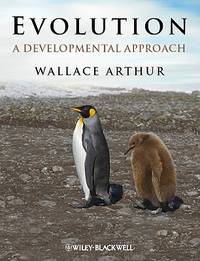
Stock photo: cover may vary
Evolution : A Developmental Approach Paperback - 2011 - 1st Edition
by Arthur, Wallace
- Used
A$39.13
A$10.14
Delivery to USA
Standard delivery: 5 to 21 days
More delivery options
Standard delivery: 5 to 21 days
Ships from Better World Books Ltd (Fife, United Kingdom)
Details
- Title Evolution : A Developmental Approach
- Author Arthur, Wallace
- Binding Paperback
- Edition number 1st
- Edition 1
- Condition Used - Very good
- Pages 416
- Volumes 1
- Language ENG
- Publisher Wiley & Sons, Incorporated, John
- Publication date 2011-02-01
- Illustrated Yes
- Features Bibliography, Illustrated, Index, Table of Contents, Textbook
- Bookseller's Inventory # 12867106-6
- ISBN 9781405186582 / 1405186585
- Weight 2.2 lbs (1.00 kg)
- Dimensions 9.6 x 7.4 x 0.9 in (24.38 x 18.80 x 2.29 cm)
- Category Science
- Library of Congress subjects Developmental biology, Evolution (Biology)
- Library of Congress Catalogue Number 2010040517
- Dewey Decimal Code 571.8
- Quantity available 1
About Better World Books Ltd Fife, United Kingdom
Biblio member since 2009
Better World Books is a for-profit, socially conscious business and a global online bookseller that collects and sells new and used books online, matching each purchase with a book donation. Each sale generates funds for literacy and education initiatives in the U.S., the U.K., and around the world. Since its launch in 2003, Better World Books has raised over $35 million for libraries and literacy, donated over 38 million books, and reused or recycled more than 475 million books.
Reader reviews for Evolution : A Developmental Approach
Write a review for this book
Important Terms and Guidelines
- Please focus on the book’s content and context. Also, add any personal comments as to how you enjoyed the book. Substantiate your likes and dislikes. You may make comparisons to other books.
- Reviews must be at least 140 characters in length.
- Please do not reveal critical plot elements.
- This is not a help line. Contact customer support if you need help.
Your review must not include:
- Obscenities, discriminatory language, or other insulting language not suitable for public domain
- Advertisements, “spam” content, or references to other products, offers or websites.
- Email addresses, URLs, phone numbers, physical addresses or other contact information.
- Overly critical comments about other reviews or reviewers
- Time-sensitive material (i.e. promotional tours, seminars, lectures, etc.)
- Availability, price, or alternative ordering/shipping information
From the publisher
From the rear cover
This book is aimed at students taking courses on evolution in universities and colleges. Its approach and its structure are very different from previously-published evolution texts. The core theme in this book is how evolution works by changing the course of embryonic and post-embryonic development. In other words, it is an evolution text that has been very much influenced by the new approach of evolutionary developmental biology, or 'evo-devo'.
Key themes include the following: developmental repatterning; adaptation and coadaptation; gene co-option; developmental plasticity; the origins of evolutionary novelties and body plans; and evolutionary changes in the complexity of organisms. As can be seen from this list, the book includes information across the levels of the gene, the organism, and the population. It also includes the issue of mapping developmental changes onto evolutionary trees. The examples used to illustrate particular points range widely, including animals, plants and fossils.
Media reviews
Citations
- Choice, 09/01/2011, Page 0
- Reference and Research Bk News, 06/01/2011, Page 224

