
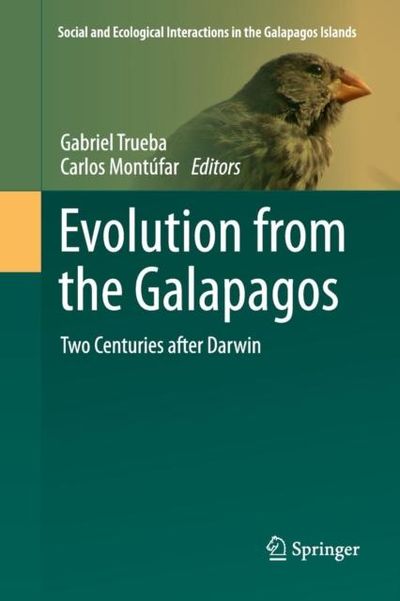
Evolution from the Galapagos : Two Centuries after Darwin Paperback - 2015
by GABRIEL TRUEBA
- New
- Paperback
A$196.65
A$15.26
Delivery to USA
Standard delivery: 7 to 12 days
More delivery options
Standard delivery: 7 to 12 days
Ships from Ria Christie Collections (Greater London, United Kingdom)
Details
- Title Evolution from the Galapagos : Two Centuries after Darwin
- Author GABRIEL TRUEBA
- Binding Paperback
- Condition New
- Language ENG
- Publisher Springer
- Publication date 2015
- Features Illustrated
- Bookseller's Inventory # ria9781489991355_inp
- ISBN 9781489991355
-
Themes
- Topical: Ecology
- Quantity available 405
About Ria Christie Collections Greater London, United Kingdom
Biblio member since 2014
Hello We are professional online booksellers. We sell mostly new books and textbooks and we do our best to provide a competitive price. We are based in Greater London, UK. We pride ourselves by providing a good customer service throughout, shipping the items quickly and replying to customer queries promptly. Ria Christie Collections
30 day return guarantee, with full refund including original shipping costs for up to 30 days after delivery if an item arrives misdescribed or damaged.
Reader reviews for Evolution from the Galapagos : Two Centuries after Darwin
Write a review for this book
Important Terms and Guidelines
- Please focus on the book’s content and context. Also, add any personal comments as to how you enjoyed the book. Substantiate your likes and dislikes. You may make comparisons to other books.
- Reviews must be at least 140 characters in length.
- Please do not reveal critical plot elements.
- This is not a help line. Contact customer support if you need help.
Your review must not include:
- Obscenities, discriminatory language, or other insulting language not suitable for public domain
- Advertisements, “spam” content, or references to other products, offers or websites.
- Email addresses, URLs, phone numbers, physical addresses or other contact information.
- Overly critical comments about other reviews or reviewers
- Time-sensitive material (i.e. promotional tours, seminars, lectures, etc.)
- Availability, price, or alternative ordering/shipping information
From the publisher
From the rear cover
In 2001 Lynn Margulis visited the main campus of the Universidad San Francisco de Quito to give the commencement address and to travel to the Tiputini Biodiversity Station in the Ecuadorian Amazonia. We felt privileged to be part of her entourage for this trip to the rainforest and to have the opportunity to listen her descriptions of hundreds of plants, fungi, insects, slime molds, and even symbiotic protists inhabiting the guts of primitive termites. During this trip Lynn expressed the need to promote a more comprehensive perspective on biological evolution, one that takes in account not only the classical and modern interpretations of Darwin's ideas but also the mechanisms of microbial evolution, especially symbiogenesis -the process that gave rise to eucaryotes more than two billion years ago and has continued to shape protists and multicellular organisms ever since. It was clear that evolutionary science was concentrated primarily on macroscopic biota while neglecting microbes almost entirely.
Those conversations became the main motivation to bring some of the most important minds working in evolutionary science to the very place that inspired Charles Darwin, the Galapagos Islands. During the summers of 2005 and 2009 we gathered scientists specializing on plants, animals, bacteria and, protists to discuss the peculiarities of evolutionary mechanisms within each domain of life. This book contains some of the most important lectures presented at the first two World Summits on Evolution.
