
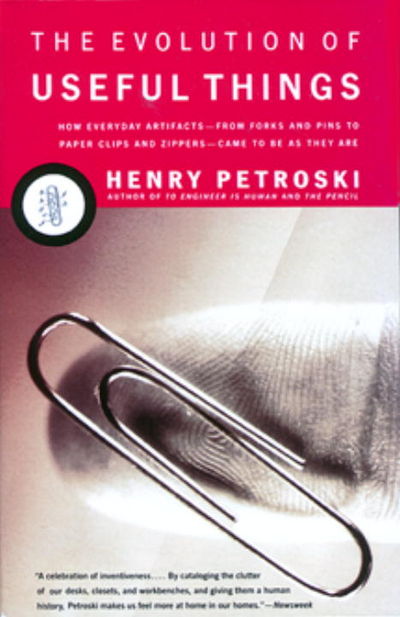
Stock photo: cover may vary
The Evolution of Useful Things: How Everyday Artifacts-From Forks and Pins to Paper Clips and Zippers-Came to be as They are Paperback - 1994
by Petroski, Henry
- Used
- Good
- Paperback
Petroski tells fascinating stories about the arduous processes that resulted in paper clips, Post-its, Phillips-head screwdrivers, Scotch tape, and fast-food "clamshell" containers. "Petroski . . . an examines the simplest . . . tools in our lives with an appraising eye".--Washington Post Book World. 45 illus.
A$8.14
Free Delivery within USA
Standard delivery: 4 to 8 days
More delivery options
Standard delivery: 4 to 8 days
Ships from Your Online Bookstore (Texas, United States)
Details
- Title The Evolution of Useful Things: How Everyday Artifacts-From Forks and Pins to Paper Clips and Zippers-Came to be as They are
- Author Petroski, Henry
- Binding Paperback
- Edition Reprint
- Condition Used - Good
- Pages 304
- Volumes 1
- Language ENG
- Publisher Vintage, New York
- Publication date 1994-02-01
- Illustrated Yes
- Features Bibliography, Illustrated, Index
- Bookseller's Inventory # 0679740392-3-22791024
- ISBN 9780679740391 / 0679740392
- Weight 0.48 lbs (0.22 kg)
- Dimensions 7.96 x 5.24 x 0.65 in (20.22 x 13.31 x 1.65 cm)
- Size 5x0x8
- Category History - General History
- Library of Congress subjects Inventions, Patents
- Library of Congress Catalogue Number 93006351
- Dewey Decimal Code 609
- Quantity available 1
About Your Online Bookstore Texas, United States
Biblio member since 2012
We provide a 30 day return guarantee, with full refund including shipping costs for up to 30 days after delivery if an item arrives damaged or not as it was described in the listing.
Reader reviews for The Evolution of Useful Things: How Everyday Artifacts-From Forks and Pins to Paper Clips and Zippers-Came to be as They are
Review summary
Readers found Henry Petroski's examination of everyday objects intellectually rewarding but stylistically challenging. The book's central thesis—that form follows failure rather than function—resonated with many, and specific case studies about paperclips, forks, and zippers fascinated audiences. However, critics consistently noted that Petroski's academic writing style, heavy reliance on technical detail, and repetitive reinforcement of his argument made the book a laborious read. Many felt the book would have benefited from more engaging prose, better illustrations, and tighter editing. Overall, it was viewed as thought-provoking content undermined by pedestrian presentation.
Readers say this book is:
insightful thorough tedious repetitive fascinating dry well-researched pedantic thought-provoking engagingWrite a review for this book
Important Terms and Guidelines
- Please focus on the book’s content and context. Also, add any personal comments as to how you enjoyed the book. Substantiate your likes and dislikes. You may make comparisons to other books.
- Reviews must be at least 140 characters in length.
- Please do not reveal critical plot elements.
- This is not a help line. Contact customer support if you need help.
Your review must not include:
- Obscenities, discriminatory language, or other insulting language not suitable for public domain
- Advertisements, “spam” content, or references to other products, offers or websites.
- Email addresses, URLs, phone numbers, physical addresses or other contact information.
- Overly critical comments about other reviews or reviewers
- Time-sensitive material (i.e. promotional tours, seminars, lectures, etc.)
- Availability, price, or alternative ordering/shipping information
From the publisher
From the jacket flap
Petroski tells fascinating stories about the arduous processes that resulted in paper clips, Post-its, Phillips-head screwdrivers, Scotch tape, and fast-food "clamshell" containers. "Petroski . . . an examines the simplest . . . tools in our lives with an appraising eye."--Washington Post Book World. 45 illus.
Media reviews
Citations
- Rec Ref Bks in Paperback, 01/01/2000, Page 93

