
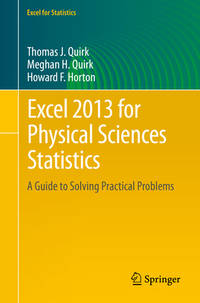
Stock photo: cover may vary
Excel 2013 for Physical Sciences Statistics: A Guide to Solving Practical Problems (Excel for Statistics) Papeback -
by Thomas J. Quirk; Meghan H. Quirk; Howard F. Horton
- New
A$237.81
A$5.78
Delivery within USA
Standard delivery: 9 to 14 days
More delivery options
Standard delivery: 9 to 14 days
Ships from Cold Books (New York, United States)
Details
- Title Excel 2013 for Physical Sciences Statistics: A Guide to Solving Practical Problems (Excel for Statistics)
- Author Thomas J. Quirk; Meghan H. Quirk; Howard F. Horton
- Binding Papeback
- Condition New
- Pages 242
- Volumes 1
- Language ENG
- Publisher Springer
- Publication date pp. 242
- Bookseller's Inventory # 6375062713
- ISBN 9783319289632 / 3319289632
- Weight 9.83 lbs (4.46 kg)
- Dimensions 9.25 x 6.1 x 0.58 in (23.50 x 15.49 x 1.47 cm)
- Category Computers - Spreadsheets
- Dewey Decimal Code 519.5
- Quantity available 4
About Cold Books New York, United States
Reader reviews for Excel 2013 for Physical Sciences Statistics: A Guide to Solving Practical Problems (Excel for Statistics)
Write a review for this book
Important Terms and Guidelines
- Please focus on the book’s content and context. Also, add any personal comments as to how you enjoyed the book. Substantiate your likes and dislikes. You may make comparisons to other books.
- Reviews must be at least 140 characters in length.
- Please do not reveal critical plot elements.
- This is not a help line. Contact customer support if you need help.
Your review must not include:
- Obscenities, discriminatory language, or other insulting language not suitable for public domain
- Advertisements, “spam” content, or references to other products, offers or websites.
- Email addresses, URLs, phone numbers, physical addresses or other contact information.
- Overly critical comments about other reviews or reviewers
- Time-sensitive material (i.e. promotional tours, seminars, lectures, etc.)
- Availability, price, or alternative ordering/shipping information
From the publisher
From the rear cover
This book shows the capabilities of Microsoft Excel in teaching physical sciences statistics effectively. Similar to the previously published Excel 2010 for Physical Sciences Statistics, this book is a step-by-step exercise-driven guide for students and practitioners who need to master Excel to solve practical science problems. If understanding statistics isn't your strongest suit, you are not especially mathematically-inclined, or if you are wary of computers, this is the right book for you.
Excel, a widely available computer program for students and managers, is also an effective teaching and learning tool for quantitative analyses in science courses. Its powerful computational ability and graphical functions make learning statistics much easier than in years past. However, Excel 2013 for Physical Sciences Statistics: A Guide to Solving Practical Problems is the first book to capitalize on these improvements by teaching students and managers how toapply Excel to statistical techniques necessary in their courses and work.
Each chapter explains statistical formulas and directs the reader to use Excel commands to solve specific, easy-to-understand science problems. Practice problems are provided at the end of each chapter with their solutions in an appendix. Separately, there is a full Practice Test (with answers in an Appendix) that allows readers to test what they have learned.
Excel, a widely available computer program for students and managers, is also an effective teaching and learning tool for quantitative analyses in science courses. Its powerful computational ability and graphical functions make learning statistics much easier than in years past. However, Excel 2013 for Physical Sciences Statistics: A Guide to Solving Practical Problems is the first book to capitalize on these improvements by teaching students and managers how toapply Excel to statistical techniques necessary in their courses and work.
Each chapter explains statistical formulas and directs the reader to use Excel commands to solve specific, easy-to-understand science problems. Practice problems are provided at the end of each chapter with their solutions in an appendix. Separately, there is a full Practice Test (with answers in an Appendix) that allows readers to test what they have learned.
Suitable for undergraduates or graduate students
Includes 163 color screen shots so you can be sure you are performing Excel steps correctly
At the beginning of his academic career, Prof. Tom J. Quirk spent six years in educational research at The American Institutes for Research and Educational Testing Service. He then taught Social Psychology, Educational Psychology, General Psychology, Marketing, Management, and Accounting at Principia College, and is currently a Professor of Marketingin the George Herbert Walker School of Business & Technology at Webster University based in St. Louis, Missouri (USA) where he teaches Marketing Statistics, Marketing Research, and Pricing Strategies. He has written 60+ textbook supplements in Marketing and Management, published 20+ articles in professional journals, and presented 20+ papers at professional meetings. He holds a B.S. in Mathematics from John Carroll University, both an M.A. in Education and a Ph.D. in Educational Psychology from Stanford University, and an M.B.A. from The University of Missouri-St. Louis.
Dr. Meghan H. Quirk holds both a Ph.D. in Biological Education and an M.A. in Biological Sciences from the University of Northern Colorado (UNC) and a B.A. in Biology and Religion at Principia College in Elsah, Illinois. She has done research on foodweb dynamics at Wind Cave National Park in South Dakota and research in agro-ecology in Southern Belize. She has co-authored an article on shortgrass steppeecosystems in Photochemistry & Photobiology. She was a National Science Foundation Fellow GK-12, and currently teaches in Bailey, Colorado.
Howard F. Horton holds an MS in Biological Sciences from the University of Northern Colorado (UNC) and a BS in Biological Sciences from Mesa State College. He has worked on research projects in Pawnee National Grasslands, Rocky Mountain National Park, Long Term Ecological Research at Toolik Lake, Alaska, and Wind Cave, South Dakota. He has co-authored articles in Th e International Journal of Speleology and Th e Journal of Cave and Karst Studies. He was a National Science Foundation Fellow GK-12, and a District Wildlife Manager with the Colorado Division of Parks and Wildlife. He is currently the Angler Outreach Coordinator for Colorado Parks and Wildlife (USA).

