
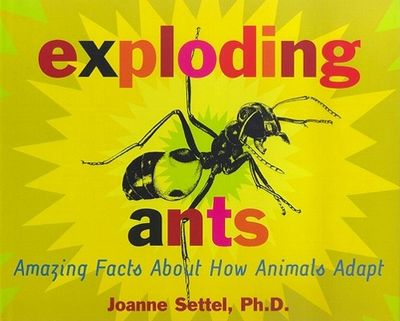
Stock photo: cover may vary
Exploding Ants: Amazing Facts About How Animals Adapt Hardback - 1999
by Settel, Joanne
- Used
- Hardback
- first
This title contains fascinating stories of how creatures adapt to the natural world in order to feed themselves, care for their young, and find safety in their environment. Illustrations.
A$11.11
Free Delivery within USA
Standard delivery: 5 to 10 days
More delivery options
Standard delivery: 5 to 10 days
Dropship order
Ships from Ergodebooks (Texas, United States)
Details
- Title Exploding Ants: Amazing Facts About How Animals Adapt
- Author Settel, Joanne
- Binding Hardback
- Edition First Edition
- Condition Used: Good
- Pages 40
- Volumes 1
- Language ENG
- Publisher Atheneum Books for Young Readers, New York
- Publication date 1999-04-01
- Illustrated Yes
- Features Bibliography, Illustrated, Index
- Bookseller's Inventory # SONG0689817398
- ISBN 9780689817397 / 0689817398
- Weight 0.85 lbs (0.39 kg)
- Dimensions 8.34 x 10.32 x 0.41 in (21.18 x 26.21 x 1.04 cm)
- Size 10.00x0.40x8.00
- Age range 07 to 10 years
- Grade levels 2 - 5
- Reading level 1020
- Category Children's Books/Ages 9-12 Nonfiction
- Library of Congress subjects Animal behavior, Animals - Habits and behavior
- Library of Congress Catalogue Number 97035395
- Dewey Decimal Code 591.5
- Quantity available 1
About Ergodebooks Texas, United States
Biblio member since 2005
Our goal is to provide best customer service and good condition books for the lowest possible price. We are always honest about condition of book. We list book only by ISBN # and hence exact book is guaranteed.
We have 30 day return policy.
Summary
A wasp lays its eggs under a
caterpillar's skin so that its young can
eat the caterpillar's guts as they grow.
A young head louse makes its home
on a human hair and feasts on
human blood.
Frogs use their eyeballs to help
swallow their food.
From small worms that live in a dog's nose mucus to exploding ants to regurgitating mother gulls, this book tells of the unusual ways animals find food, shelter, and safety in the natural world.
If animals all ate the same things and lived in the same places, it would be impossible for all of them to survive. So they specialize. Some animals eat the bits that others leave behind, such as skin and mucus. They find all kinds of unusual places to shelter, including the cracks and holes in another creature's skin or its internal organs. They use their own bodies to protect themselves from predators by imitating unsavory items such as bird droppings and even by blowing up.
These habits that may seem disgusting to us are wonderful adaptations that make it possible for a great variety of creatures to live and thrive on Earth. Read about them and marvel at the amazing ways animals adapt to the natural world.
caterpillar's skin so that its young can
eat the caterpillar's guts as they grow.
A young head louse makes its home
on a human hair and feasts on
human blood.
Frogs use their eyeballs to help
swallow their food.
From small worms that live in a dog's nose mucus to exploding ants to regurgitating mother gulls, this book tells of the unusual ways animals find food, shelter, and safety in the natural world.
If animals all ate the same things and lived in the same places, it would be impossible for all of them to survive. So they specialize. Some animals eat the bits that others leave behind, such as skin and mucus. They find all kinds of unusual places to shelter, including the cracks and holes in another creature's skin or its internal organs. They use their own bodies to protect themselves from predators by imitating unsavory items such as bird droppings and even by blowing up.
These habits that may seem disgusting to us are wonderful adaptations that make it possible for a great variety of creatures to live and thrive on Earth. Read about them and marvel at the amazing ways animals adapt to the natural world.
Reader reviews for Exploding Ants: Amazing Facts About How Animals Adapt
Write a review for this book
Important Terms and Guidelines
- Please focus on the book’s content and context. Also, add any personal comments as to how you enjoyed the book. Substantiate your likes and dislikes. You may make comparisons to other books.
- Reviews must be at least 140 characters in length.
- Please do not reveal critical plot elements.
- This is not a help line. Contact customer support if you need help.
Your review must not include:
- Obscenities, discriminatory language, or other insulting language not suitable for public domain
- Advertisements, “spam” content, or references to other products, offers or websites.
- Email addresses, URLs, phone numbers, physical addresses or other contact information.
- Overly critical comments about other reviews or reviewers
- Time-sensitive material (i.e. promotional tours, seminars, lectures, etc.)
- Availability, price, or alternative ordering/shipping information
From the publisher
Media reviews
Citations
- Booklist, 04/15/1999, Page 1527
- Hornbook Guide to Children, 01/01/1999, Page 341
- Kirkus Review - Children, 04/01/1999, Page 538
- School Library Journal, 04/01/1999, Page 156

