
Stock photo: cover may vary
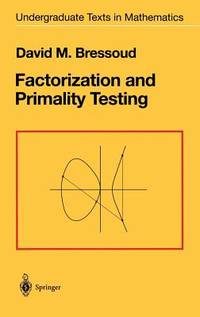
Factorization and Primality Testing Hardback - 1989
by Bressoud, D. M
- Used
- Fine
- Hardback
- first
A$82.60
A$7.23
Delivery within USA
Standard delivery: 7 to 14 days
More delivery options
Standard delivery: 7 to 14 days
Details
- Title Factorization and Primality Testing
- Author Bressoud, D. M
- Binding Hardback
- Edition First Edition / First Printing
- Condition Used - Fine
- Pages 240
- Volumes 1
- Language ENG
- Publisher Springer-Verlag New York, Incorporated, New York, New York, U.S.A.
- Publication date 1989
- Illustrated Yes
- Features Illustrated
- Bookseller's Inventory # 034196
- ISBN 9780387970400 / 0387970401
- Weight 1.09 lbs (0.49 kg)
- Dimensions 9.5 x 6.42 x 0.79 in (24.13 x 16.31 x 2.01 cm)
- Category Mathematics
- Library of Congress subjects Numbers, Prime, Factorization (Mathematics)
- Library of Congress Catalogue Number 89-19690
- Dewey Decimal Code 512.72
- Bookseller catalogues Mathematics
About Conover Books Virginia, United States
Specialising in: Autographed Copys, Collectible Titles, Comic Books, First Editions, Out-Of-Print, Romance, Sports Magazines, Vintage Titles
Biblio member since 2004
We offer quality used books at great low prices! Our store is stocked with every genre old and new! Rare out-of-prints and many first editions! We are an internet and walk-in dealer.
Visa, MasterCard, Discover and American Express credit cards accepted. We also accept Bankdrafts, Money Orders and personal checks (book will not be sent til check clears). We offer a full book guarantee, if for any reason a customer is not satisfied with their purchase, they may return their purchase for a full refund *NOTE: Return policy includes full reimbursement for the book (books) purchased excluding return shipping cost which is the responsibility of the purchaser. Conover Books will accept all returns within 7 days from receipt of the book (books) purchased
Reader reviews for Factorization and Primality Testing
Write a review for this book
Important Terms and Guidelines
- Please focus on the book’s content and context. Also, add any personal comments as to how you enjoyed the book. Substantiate your likes and dislikes. You may make comparisons to other books.
- Reviews must be at least 140 characters in length.
- Please do not reveal critical plot elements.
- This is not a help line. Contact customer support if you need help.
Your review must not include:
- Obscenities, discriminatory language, or other insulting language not suitable for public domain
- Advertisements, “spam” content, or references to other products, offers or websites.
- Email addresses, URLs, phone numbers, physical addresses or other contact information.
- Overly critical comments about other reviews or reviewers
- Time-sensitive material (i.e. promotional tours, seminars, lectures, etc.)
- Availability, price, or alternative ordering/shipping information

