
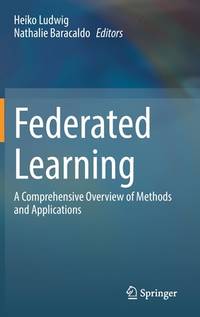
Stock photo: cover may vary
Federated Learning: A Comprehensive Overview of Methods and Applications Hardback - 2022
by Heiko Ludwig (Editor); Nathalie Baracaldo (Editor)
- New
- Hardback
A$409.54
A$5.77
Delivery within USA
Standard delivery: 9 to 14 days
More delivery options
Standard delivery: 9 to 14 days
Ships from Cold Books (New York, United States)
Details
- Title Federated Learning: A Comprehensive Overview of Methods and Applications
- Author Heiko Ludwig (Editor); Nathalie Baracaldo (Editor)
- Binding Hardback
- Condition New
- Pages 534
- Volumes 1
- Language ENG
- Publisher Springer
- Publication date 1st ed. 2022 edition NO-PA1
- Illustrated Yes
- Features Illustrated
- Bookseller's Inventory # 6396287073
- ISBN 9783030968953 / 3030968952
- Weight 2.06 lbs (0.93 kg)
- Dimensions 9.21 x 6.14 x 1.19 in (23.39 x 15.60 x 3.02 cm)
- Category Computers - General Information
- Quantity available 4
About Cold Books New York, United States
Reader reviews for Federated Learning: A Comprehensive Overview of Methods and Applications
Write a review for this book
Important Terms and Guidelines
- Please focus on the book’s content and context. Also, add any personal comments as to how you enjoyed the book. Substantiate your likes and dislikes. You may make comparisons to other books.
- Reviews must be at least 140 characters in length.
- Please do not reveal critical plot elements.
- This is not a help line. Contact customer support if you need help.
Your review must not include:
- Obscenities, discriminatory language, or other insulting language not suitable for public domain
- Advertisements, “spam” content, or references to other products, offers or websites.
- Email addresses, URLs, phone numbers, physical addresses or other contact information.
- Overly critical comments about other reviews or reviewers
- Time-sensitive material (i.e. promotional tours, seminars, lectures, etc.)
- Availability, price, or alternative ordering/shipping information
From the publisher
From the rear cover
Federated Learning: A Comprehensive Overview of Methods and Applications presents an in-depth discussion of the most important issues and approaches to federated learning for researchers and practitioners.
Federated Learning (FL) is an approach to machine learning in which the training data are not managed centrally. Data are retained by data parties that participate in the FL process and are not shared with any other entity. This makes FL an increasingly popular solution for machine learning tasks for which bringing data together in a centralized repository is problematic, either for privacy, regulatory or practical reasons.
This book explains recent progress in research and the state-of-the-art development of Federated Learning (FL), from the initial conception of the field to first applications and commercial use. To obtain this broad and deep overview, leading researchers address the different perspectives of federated learning: the core machine learning perspective, privacy and security, distributed systems, and specific application domains. Readers learn about the challenges faced in each of these areas, how they are interconnected, and how they are solved by state-of-the-art methods.
Following an overview on federated learning basics in the introduction, over the following 24 chapters, the reader will dive deeply into various topics. The first part addresses algorithmic questions of solving different machine learning tasks in a federated way and how to train efficiently, at scale, and fairly. Another part focuses on providing clarity on how to select privacy and security solutions in a way that can be tailored to specific use cases, while another considers the pragmatics of the systems where the federated learning process will run. The book also covers other important use cases for federated learning, such as split learning and vertical federated learning. Finally, the book includes some chapters focusing on applying FL in real-world enterprise settings.
Federated Learning (FL) is an approach to machine learning in which the training data are not managed centrally. Data are retained by data parties that participate in the FL process and are not shared with any other entity. This makes FL an increasingly popular solution for machine learning tasks for which bringing data together in a centralized repository is problematic, either for privacy, regulatory or practical reasons.
This book explains recent progress in research and the state-of-the-art development of Federated Learning (FL), from the initial conception of the field to first applications and commercial use. To obtain this broad and deep overview, leading researchers address the different perspectives of federated learning: the core machine learning perspective, privacy and security, distributed systems, and specific application domains. Readers learn about the challenges faced in each of these areas, how they are interconnected, and how they are solved by state-of-the-art methods.
Following an overview on federated learning basics in the introduction, over the following 24 chapters, the reader will dive deeply into various topics. The first part addresses algorithmic questions of solving different machine learning tasks in a federated way and how to train efficiently, at scale, and fairly. Another part focuses on providing clarity on how to select privacy and security solutions in a way that can be tailored to specific use cases, while another considers the pragmatics of the systems where the federated learning process will run. The book also covers other important use cases for federated learning, such as split learning and vertical federated learning. Finally, the book includes some chapters focusing on applying FL in real-world enterprise settings.

