BIBLIO is the largest independent book marketplace in the world, with over 100 million books.

Skip to content

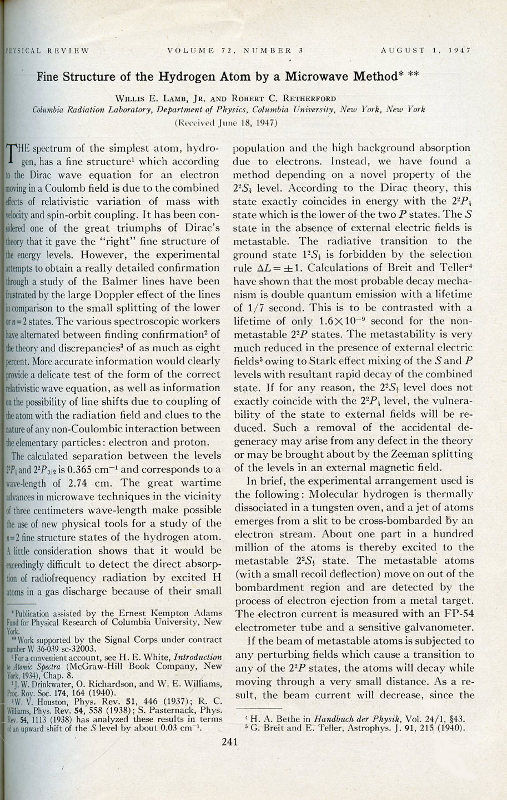
Fine Structure of the Hydrogen Atom by a Microwave Method, in Physical Review, Vol. 72, No. 3, August 1, 1947, pp. 241-243

Fine Structure of the Hydrogen Atom by a Microwave Method, in Physical Review, Vol. 72, No. 3, August 1, 1947, pp. 241-243

Click to view full size.
Fine Structure of the Hydrogen Atom by a Microwave Method, in Physical Review, Vol. 72, No. 3, August 1, 1947, pp. 241-243 1947

by Lamb, Willis E., Robert C. Retherford and Hans Bethe

Add to wish list
  • Used
  • Paperback
  • first

Description

Lancaster: American Physical Society, 1947. 1st Edition. FIRST EDITION, FIRST ISSUE IN ORIGINAL WRAPS of the paper in which Lamb announced the fine structure of the hydrogen atom, discovered the discrepancy in electromagnetic theory called the Lamb Shift, and began the revolution that led to Quantum Electrodynamics (QED).

QED basically describes how light and matter interact, addressing it as a small difference between energy levels of two orbitals of the hydrogen atom that was unexplained and at odds with prevailing electromagnetic theory, then Dirac's quantum theory of the electron. Lamb explains "electromagnetic attraction and repulsion... in terms of the exchange of photons between charged particles" (Peacock, The Quantum Revolution, 100).

The Lamb Shift, then, is a small difference between energy levels of two orbitals of the hydrogen atom that was unexplained and at odds with prevailing electromagnetic theory, then Dirac's quantum theory of the electron. This small difference, caused by the interaction between the electron and the vacuum, became the impetus for the development of QED. QED, sometimes said to be the most accurate physical theory ever written, became the model for quantum field theories that would be developed in the future" (ibid). Able to mathematically describe all phenomena involving electrically charged particles interacting by means of exchange of photons, QED can make extremely accurate predictions. Richard Feynman has called it "the jewel of physics" for this reason.

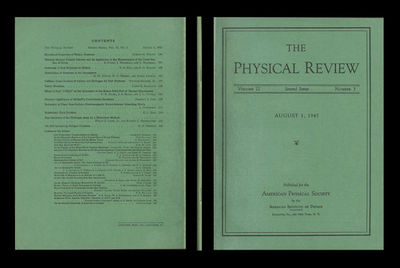
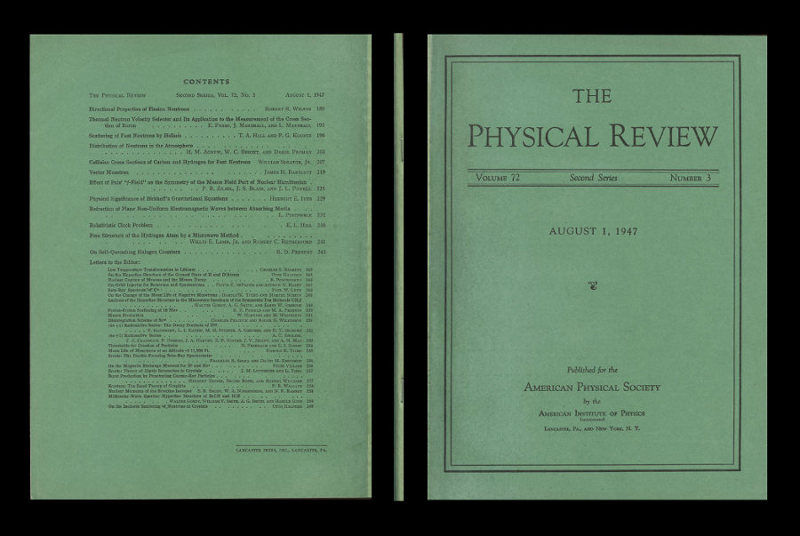
In 1955, Lamb was awarded the Noble Prize along with P. Kusch (whose paper is also included here) "for his discoveries concerning the fine structure of the hydrogen spectrum" (Noble Prize Committee). CONDITION & DETAILS: Volume 72, Number 3. Original Wraps 4to (10.5 x 8 inches; 263 x 200mm). Meticulously rebacked at the spine to match the green of the wraps. The wraps are in near fine condition, as is the interior. NOTE THAT THE WRAPS ARE FAR BRIGHTER THAN THEY APPEAR IN THE PICTURE; IT IS JUST A DARK IMAGE FOR SOME REASON.
Ask the seller a question Add to wish list
A$1,166.96
A$18.82 Delivery within USA
Standard delivery: 2 to 4 days
More delivery options
Ships from Atticus Rare Books (Iowa, United States)

Details

  • Title Fine Structure of the Hydrogen Atom by a Microwave Method, in Physical Review, Vol. 72, No. 3, August 1, 1947, pp. 241-243
  • Author Lamb, Willis E., Robert C. Retherford and Hans Bethe
  • Binding Paperback
  • Edition 1st Edition
  • Publisher American Physical Society, Lancaster
  • Publication date 1947
  • Bookseller's Inventory # 223
  • Quantity available 1

About Atticus Rare Books Iowa, United States

Biblio member since 2010

We specialize in rare and unusual antiquarian books in the sciences and the history of science. Additionally, we specialize in 20th century physics, mathematics, and astronomy.

Terms of Sale: 30 day return guarantee, with full refund including shipping costs for up to 30 days after delivery if an item arrives misdescribed or damaged.

Browse books from Atticus Rare Books

tracking-