

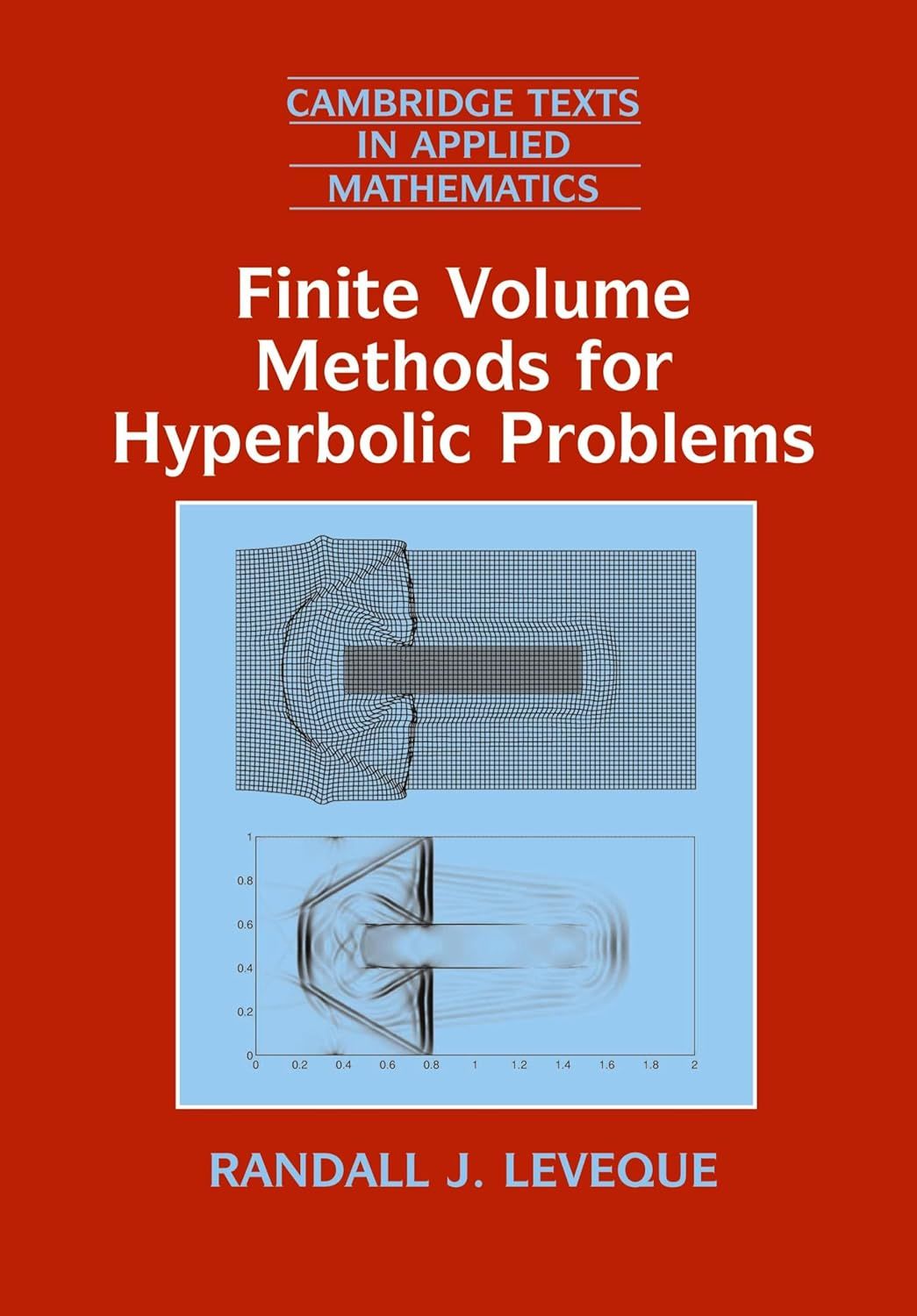
Finite Volume Methods for Hyperbolic Problems Paperback - 2002
by Randall J. LeVeque (Author)
- Used
- Paperback
A$37.78
A$80.01
Delivery to USA
Standard delivery: 14 to 21 days
More delivery options
Standard delivery: 14 to 21 days
Ships from Pentz Booksellers (South Africa)
Details
- Title Finite Volume Methods for Hyperbolic Problems
- Author Randall J. LeVeque (Author)
- Binding Paperback
- Edition International Ed
- Pages 580
- Volumes 1
- Language ENG
- Publisher Cambridge University Press
- Publication date 2002-08-26
- Features Bibliography
- Bookseller's Inventory # finite-volume-methods-for
- ISBN 9780521009249 / 0521009243
- Weight 2.08 lbs (0.94 kg)
- Dimensions 9.7 x 6.84 x 1.14 in (24.64 x 17.37 x 2.90 cm)
- Category Mathematics
- Library of Congress subjects Differential equations, Hyperbolic -, Finite volume method
- Library of Congress Catalogue Number 2001052642
- Dewey Decimal Code 515.353
- Quantity available 1
About Pentz Booksellers South Africa
Specialising in: Academic, African Literature, Africana History, Africana Politics And Economics, Collectibles, English Classics And Contemporary, Global History, Science And Engineering, Urban Cities
Biblio member since 2021
Pentz Booksellers, founded in 1992 by Pentz, has expanded over the years and today carries more than 30 000 titles. The Campus Bookstore serves students, academics, universities and institutions with a wide range and in-depth assortment of general, academic, technical, professional and educational books. We also provide a wide variety of light reading and books that fit neither the academic nor mass-market mould.
Reader reviews for Finite Volume Methods for Hyperbolic Problems
Write a review for this book
Important Terms and Guidelines
- Please focus on the book’s content and context. Also, add any personal comments as to how you enjoyed the book. Substantiate your likes and dislikes. You may make comparisons to other books.
- Reviews must be at least 140 characters in length.
- Please do not reveal critical plot elements.
- This is not a help line. Contact customer support if you need help.
Your review must not include:
- Obscenities, discriminatory language, or other insulting language not suitable for public domain
- Advertisements, “spam” content, or references to other products, offers or websites.
- Email addresses, URLs, phone numbers, physical addresses or other contact information.
- Overly critical comments about other reviews or reviewers
- Time-sensitive material (i.e. promotional tours, seminars, lectures, etc.)
- Availability, price, or alternative ordering/shipping information
From the publisher
First line
To see how conservation laws arise from physical principles, we will begin by considering the simplest possible fluid dynamics problem, in which a gas or liquid is flowing through a one-dimensional pipe with some known velocity u(x, t), which is assumed to vary only with x, the distance along the pipe, and time t.

