
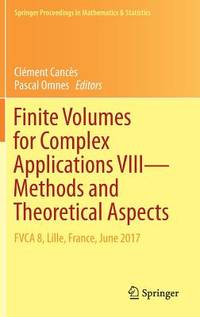
Stock photo: cover may vary
Finite Volumes for Complex Applications VIII - Methods and Theoretical Aspects.: FVCA 8, Lille, France, June 2017. Hardback - 2017
by Cancès, Clément; Omnes, Pascal (Eds.)
- Used
- Hardback
A$104.21
A$33.08
Delivery to USA
Standard delivery: 7 to 21 days
More delivery options
Standard delivery: 7 to 21 days
Ships from Lange & Springer Antiquariat (Germany)
Details
- Title Finite Volumes for Complex Applications VIII - Methods and Theoretical Aspects.
- Author Cancès, Clément; Omnes, Pascal (Eds.)
- Binding Hardback
- Pages XII, 476 p
- Publisher Springer
- Publication date 2017
- Features Illustrated
- Bookseller's Inventory # 10786GB
- ISBN 9783319573960
About Lange & Springer Antiquariat Germany
Specialising in: Astrology, Chemistry, Engineering, Humanities, Mathematics, Medicine, Natural Science, Old and rare scientific books
Biblio member since 2025
Lange & Springer Antiquariat (est. 1816) is a long-established scientific antiquarian bookstore based in Berlin. We specialize in rare and scholarly books spanning the sciences, medicine, mathematics, engineering, and the humanities — from historically significant early works to modern academic literature. Our curated selection includes antiquarian treasures as well as contemporary academic titles for researchers, collectors, and institutions worldwide.
Reader reviews for Finite Volumes for Complex Applications VIII - Methods and Theoretical Aspects.
Write a review for this book
Important Terms and Guidelines
- Please focus on the book’s content and context. Also, add any personal comments as to how you enjoyed the book. Substantiate your likes and dislikes. You may make comparisons to other books.
- Reviews must be at least 140 characters in length.
- Please do not reveal critical plot elements.
- This is not a help line. Contact customer support if you need help.
Your review must not include:
- Obscenities, discriminatory language, or other insulting language not suitable for public domain
- Advertisements, “spam” content, or references to other products, offers or websites.
- Email addresses, URLs, phone numbers, physical addresses or other contact information.
- Overly critical comments about other reviews or reviewers
- Time-sensitive material (i.e. promotional tours, seminars, lectures, etc.)
- Availability, price, or alternative ordering/shipping information
From the publisher
From the rear cover
This first volume of the proceedings of the 8th conference on "Finite Volumes for Complex Applications" (Lille, June 2017) covers various topics including convergence and stability analysis, as well as investigations of these methods from the point of view of compatibility with physical principles. It collects together the focused invited papers comparing advanced numerical methods for Stokes and Navier-Stokes equations on a benchmark, as well as reviewed contributions from internationally leading researchers in the field of analysis of finite volume and related methods, offering a comprehensive overview of the state of the art in the field. The finite volume method in its various forms is a space discretization technique for partial differential equations based on the fundamental physical principle of conservation, and recent decades have brought significant advances in the theoretical understanding of the method. Many finite volume methods preserve further qualitative or asymptotic properties, including maximum principles, dissipativity, monotone decay of free energy, and asymptotic stability. Due to these properties, finite volume methods belong to the wider class of compatible discretization methods, which preserve qualitative properties of continuous problems at the discrete level. This structural approach to the discretization of partial differential equations becomes particularly important for multiphysics and multiscale applications. The book is a valuable resource for researchers, PhD and master's level students in numerical analysis, scientific computing and related fields such as partial differential equations, as well as engineers working in numerical modeling and simulations.

