
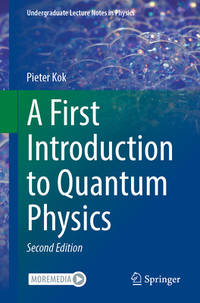
Stock photo: cover may vary
A FIRST INTRODUCTION TO QUANTUM PHYSICS Paperback - 2023
by Pieter Kok
- New
A$100.37
A$22.06
Delivery to USA
Standard delivery: 7 to 14 days
More delivery options
Standard delivery: 7 to 14 days
Details
- Title A FIRST INTRODUCTION TO QUANTUM PHYSICS
- Author Pieter Kok
- Binding Paperback
- Condition New
- Pages 296
- Volumes 1
- Language ENG
- Publisher Springer
- Publication date 2023-03-29
- Illustrated Yes
- Features Illustrated
- Bookseller's Inventory # BIBNNA-11570
- ISBN 9783031161643 / 3031161645
- Weight 0.98 lbs (0.44 kg)
- Dimensions 9.21 x 6.14 x 0.66 in (23.39 x 15.60 x 1.68 cm)
- Category Science
- Quantity available 2
About Students Textbooks India
Specialising in: International Edition., Textbooks
Biblio member since 2009
Selling textbooks, International editions and reference books online from last 5 Years.
30 day return guarantee, with full refund including shipping costs for up to 30 days after delivery if an item arrives misdescribed or damaged. Return address: Students_Textbooks 12 phankha road Jankpuri New Delhi 110036 India
Reader reviews for A FIRST INTRODUCTION TO QUANTUM PHYSICS
Write a review for this book
Important Terms and Guidelines
- Please focus on the book’s content and context. Also, add any personal comments as to how you enjoyed the book. Substantiate your likes and dislikes. You may make comparisons to other books.
- Reviews must be at least 140 characters in length.
- Please do not reveal critical plot elements.
- This is not a help line. Contact customer support if you need help.
Your review must not include:
- Obscenities, discriminatory language, or other insulting language not suitable for public domain
- Advertisements, “spam” content, or references to other products, offers or websites.
- Email addresses, URLs, phone numbers, physical addresses or other contact information.
- Overly critical comments about other reviews or reviewers
- Time-sensitive material (i.e. promotional tours, seminars, lectures, etc.)
- Availability, price, or alternative ordering/shipping information
From the publisher
From the rear cover
In this undergraduate textbook, now in its 2nd edition, the author develops the quantum theory from first principles based on very simple experiments: a photon traveling through beam splitters to detectors, an electron moving through magnetic fields, and an atom emitting radiation. From the physical description of these experiments follows a natural mathematical description in terms of matrices and complex numbers.
The first part of the book examines how experimental facts force us to let go of some deeply held preconceptions and develops this idea into a description of states, probabilities, observables, and time evolution. The quantum mechanical principles are illustrated using applications such as gravitational wave detection, magnetic resonance imaging, atomic clocks, scanning tunneling microscopy, and many more. The first part concludes with an overview of the complete quantum theory.
The second part of the book covers more advanced topics, including the concept of entanglement, the process of decoherence or how quantum systems become classical, quantum computing and quantum communication, and quantum particles moving in space. Here, the book makes contact with more traditional approaches to quantum physics. The remaining chapters delve deeply into the idea of uncertainty relations and explore what the quantum theory says about the nature of reality.
The book is an ideal accessible introduction to quantum physics, tested in the classroom, with modern examples and plenty of end-of-chapter exercises.
The first part of the book examines how experimental facts force us to let go of some deeply held preconceptions and develops this idea into a description of states, probabilities, observables, and time evolution. The quantum mechanical principles are illustrated using applications such as gravitational wave detection, magnetic resonance imaging, atomic clocks, scanning tunneling microscopy, and many more. The first part concludes with an overview of the complete quantum theory.
The second part of the book covers more advanced topics, including the concept of entanglement, the process of decoherence or how quantum systems become classical, quantum computing and quantum communication, and quantum particles moving in space. Here, the book makes contact with more traditional approaches to quantum physics. The remaining chapters delve deeply into the idea of uncertainty relations and explore what the quantum theory says about the nature of reality.
The book is an ideal accessible introduction to quantum physics, tested in the classroom, with modern examples and plenty of end-of-chapter exercises.

