
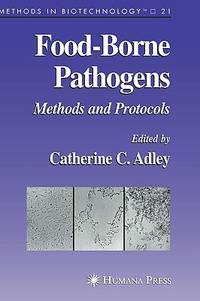
Stock photo: cover may vary
Food-Borne Pathogens: Methods and Protocols (Methods in Biotechnology, 21) Hardback - 2005
by Catherine Adley (Editor)
- Used
- Good
- Hardback
A$32.26
A$37.75
Delivery to USA
Standard delivery: 5 to 28 days
More delivery options
Standard delivery: 5 to 28 days
Details
- Title Food-Borne Pathogens: Methods and Protocols (Methods in Biotechnology, 21)
- Author Catherine Adley (Editor)
- Binding Hardback
- Edition U. S. EDITION
- Condition Used - Good
- Pages 268
- Volumes 1
- Language ENG
- Publisher Humana
- Publication date 2005
- Illustrated Yes
- Features Bibliography, Illustrated, Index
- Bookseller's Inventory # H-088-554
- ISBN 9781588294654 / 158829465X
- Weight 1.58 lbs (0.72 kg)
- Dimensions 9.36 x 6.34 x 1.02 in (23.77 x 16.10 x 2.59 cm)
- Category Science
- Library of Congress subjects Food - Microbiology, Food Microbiology
- Library of Congress Catalogue Number 2005007292
- Dewey Decimal Code 579
- Quantity available 1
About AMMAREAL France
Biblio member since 2020
Ammareal is a professional bookseller specialized in used books. We ship worldwide. We have more than 1 million books in stock, including a large number of technical and university-level books. We give back up to 15% of the price of each book to charities, libraries and organizations fighting in favor of literacy. What we do not sell, we give ; what we do not give, we recycle.
Reader reviews for Food-Borne Pathogens: Methods and Protocols (Methods in Biotechnology, 21)
Write a review for this book
Important Terms and Guidelines
- Please focus on the book’s content and context. Also, add any personal comments as to how you enjoyed the book. Substantiate your likes and dislikes. You may make comparisons to other books.
- Reviews must be at least 140 characters in length.
- Please do not reveal critical plot elements.
- This is not a help line. Contact customer support if you need help.
Your review must not include:
- Obscenities, discriminatory language, or other insulting language not suitable for public domain
- Advertisements, “spam” content, or references to other products, offers or websites.
- Email addresses, URLs, phone numbers, physical addresses or other contact information.
- Overly critical comments about other reviews or reviewers
- Time-sensitive material (i.e. promotional tours, seminars, lectures, etc.)
- Availability, price, or alternative ordering/shipping information
From the publisher
From the rear cover
The large-scale production and distribution of prepared foods have made rapid and accurate biological testing a daily necessity for the food industry. In Food-Borne Pathogens: Methods and Protocols, expert laboratory scientists describe in a readily reproducible format the classic and emerging molecular methods for the laboratory isolation and identification of the pathogens, viruses, and parasites that cause food-borne disease. Among the pathogens covered are specific bacteria, including Salmonella spp., Campylobacter spp., Listeria spp., and Bacillus spp.; viruses, including noroviruses and enteroviruses, and parasites, including Cryptosporidium and seafood nematode worms. The authors also review toxin detection kits, the use of high performance liquid chromatography, the proper control of bacterial storage conditions, and the importance of surveillance systems and risk assessment. The protocols follow the successful Methods in Biotechnology(TM) series format, each offering step-by-step laboratory instructions, an introduction outlining the principles behind the technique, lists of the necessary equipment and reagents, and tips on troubleshooting and avoiding known pitfalls.
Cutting-edge and highly practical, Food-Borne Pathogens: Methods and Protocols offers food technologists and research scientists alike an accessible source of molecular techniques currently being used and new methodologies for testing organisms that might not have been attempted previously.
Cutting-edge and highly practical, Food-Borne Pathogens: Methods and Protocols offers food technologists and research scientists alike an accessible source of molecular techniques currently being used and new methodologies for testing organisms that might not have been attempted previously.

