BIBLIO is the largest independent book marketplace in the world, with over 100 million books.

Skip to content

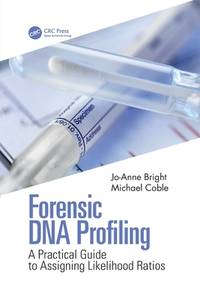
FORENSIC DNA PROFILING A PRACTICAL GUIDE TO ASSIGNING LIKELIHOOD RATIOS (PB 2021)

FORENSIC DNA PROFILING A PRACTICAL GUIDE TO ASSIGNING LIKELIHOOD RATIOS (PB 2021)

FORENSIC DNA PROFILING A PRACTICAL GUIDE TO ASSIGNING LIKELIHOOD RATIOS (PB
Stock photo: cover may vary

FORENSIC DNA PROFILING A PRACTICAL GUIDE TO ASSIGNING LIKELIHOOD RATIOS (PB 2021) Paperback - 2021

by BRIGHT J A

Add to wish list
  • New
New

Description

new.
Ask the seller a question Add to wish list
A$107.57
A$5.64 Delivery within USA
Standard delivery: 2 to 14 days
More delivery options
Ships from GreatBookPrices (Maryland, United States)

Details

About GreatBookPrices Maryland, United States

Biblio member since 2024

Since 1991, we have worked every day to serve our customers with state-of-the-art technology and world class service. We are dedicated to providing customers around the world with the widest selection of books, DVDs, and CDs at the absolute lowest price.

Terms of Sale: 30 day return guarantee, with full refund including original shipping costs for up to 30 days after delivery if an item arrives misdescribed or damaged.

Browse books from GreatBookPrices

Reader reviews for FORENSIC DNA PROFILING A PRACTICAL GUIDE TO ASSIGNING LIKELIHOOD RATIOS (PB 2021)

From the publisher

DNA testing and its forensic analysis are recognized as the "gold standard" in forensic identification science methods. However, there is a great need for a hands-on step-by-step guide to teach the forensic DNA community how to interpret DNA mixtures, how to assign a likelihood ratio, and how to use the subsequent likelihood ratio when reporting interpretation conclusions.

Forensic DNA Profiling: A Practical Guide to Assigning Likelihood Ratios will provide a roadmap for labs all over the world and the next generation of analysts who need this foundational understanding. The techniques used in forensic DNA analysis are based upon the accepted principles of molecular biology. The interpretation of a good-quality DNA profile generated from a crime scene stain from a single-source donor provides an unambiguous result when using the most modern forensic DNA methods. Unfortunately, many crime scene profiles are not single source. They are described as mixed since they contain DNA from two or more individuals.

Interpretation of DNA mixtures represents one of the greatest challenges to the forensic DNA analyst. As such, the book introduces terms used to describe DNA profiles and profile interpretation. Chapters explain DNA extraction methods, the polymerase chain reaction (PCR), capillary electrophoresis (CE), likelihood ratios (LRs) and their interpretation, and population genetic models--including Mendelian inheritance and Hardy-Weinberg equilibrium. It is important that analysts understand how LRs are generated in a probabilistic framework, ideally with an appreciation of both semicontinuous and fully continuous probabilistic approaches.

KEY FEATURES:
- The first book to focus entirely on DNA mixtures and the complexities involved with interpreting the results
- Takes a hands-on approach offering theory with worked examples and exercises to be easily understood and implementable by laboratory personnel
- New methods, heretofore unpublished previously, provide a means to innovate deconvoluting a mixed DNA profile, assign an LR, and appropriately report the weight of evidence
- Includes a chapter on assigning LRs for close relatives (i.e., "It's not me, it was my brother"), and discusses strategies for the validation of probabilistic genotyping software

Forensic DNA Profiling fills the void for labs unfamiliar with LRs, and moving to probabilistic solutions, and for labs already familiar with LRs, but wishing to understand how they are calculated in more detail. The book will be a welcome read for lab professionals and technicians, students, and legal professionals seeking to understand and apply the techniques covered.

About the author

Jo-Anne Bright, PhD, has an MSc and PhD in Forensic Science from the University of Auckland. She is a Senior Science Leader at the Institute of Environmental Science and Research Limited, in Auckland, New Zealand where she has worked since 1999. She has 20 years of experience in forensic casework, quality management, and research. She has over 70 publications in the area of forensic DNA analysis and interpretation. Dr. Bright is a co-developer of the DNA profile interpretation software STRmix(TM) and has undertaken many presentations and workshops on DNA profile interpretation in Australasia, Asia, the United States, and Europe.

Michael D. Coble, PhD, is an Associate Professor and the Associate Director of the Center for Human Identification at the University of North Texas Health Science Center in Fort Worth, Texas. Dr. Coble received his master's degree in forensic science and his PhD in genetics from The George Washington University. He is a Fellow of the American Academy of Forensic Sciences and a member of the International Society for Forensic Genetics. He serves as a member of the OSAC Biological Data Interpretation and Reporting Committee and is an invited guest at the Scientific Working Group on DNA Analysis Methods (SWGDAM). He is a co-editor of the Forensic Biology subject area of WIRE's Forensic Science journal and is a member of the editorial board of Forensic Science International: Genetics.

tracking-