
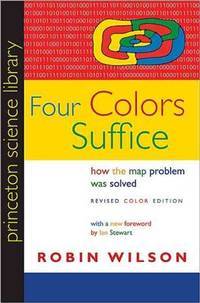
Stock photo: cover may vary
Four Colors Suffice : How the Map Problem Was Solved - Revised Color Edition Paperback - 2013
by Wilson, Robin
- Used
A$11.86
Free Delivery within USA
Standard delivery: 4 to 8 days
More delivery options
Standard delivery: 4 to 8 days
Details
- Title Four Colors Suffice : How the Map Problem Was Solved - Revised Color Edition
- Author Wilson, Robin
- Binding Paperback
- Edition Revised
- Condition Used - Good
- Pages 224
- Volumes 1
- Language ENG
- Publisher Princeton University Press, Princeton, NJ
- Publication date 2013-11-10
- Illustrated Yes
- Features Bibliography, Glossary, Illustrated, Index, Maps
- Bookseller's Inventory # 12023650-6
- ISBN 9780691158228 / 0691158223
- Weight 0.85 lbs (0.39 kg)
- Dimensions 9.33 x 6.13 x 0.47 in (23.70 x 15.57 x 1.19 cm)
-
Themes
- Aspects (Academic): Science/Technology Aspects
- Category Science
- Library of Congress subjects Four-color problem, Four-color problem - History
- Library of Congress Catalogue Number 2013017002
- Dewey Decimal Code 526
- Quantity available 1
About Better World Books Indiana, United States
Biblio member since 2005

Better World Books is a for-profit, socially conscious business and a global online bookseller that collects and sells new and used books online, matching each purchase with a book donation. Each sale generates funds for literacy and education initiatives in the U.S., the UK, and around the world. Since its launch in 2003, Better World Books has raised over $35 million for libraries and literacy, donated over 38 million books, and reused or recycled more than 475 million books.
Reader reviews for Four Colors Suffice : How the Map Problem Was Solved - Revised Color Edition
Write a review for this book
Important Terms and Guidelines
- Please focus on the book’s content and context. Also, add any personal comments as to how you enjoyed the book. Substantiate your likes and dislikes. You may make comparisons to other books.
- Reviews must be at least 140 characters in length.
- Please do not reveal critical plot elements.
- This is not a help line. Contact customer support if you need help.
Your review must not include:
- Obscenities, discriminatory language, or other insulting language not suitable for public domain
- Advertisements, “spam” content, or references to other products, offers or websites.
- Email addresses, URLs, phone numbers, physical addresses or other contact information.
- Overly critical comments about other reviews or reviewers
- Time-sensitive material (i.e. promotional tours, seminars, lectures, etc.)
- Availability, price, or alternative ordering/shipping information
From the publisher
From the rear cover
"I loved Robin Wilson's book on the four color problem, because it gives the history as well as the arguments. The history is presented so entertainingly, and the arguments so lucidly, that I'm sure the book will find a large audience, and delight any audience as much as it did me."--John Conway
"An intriguing historical account of one of the most baffling enigmas in mathematics: the Four Color Theorem. Robin Wilson provides fascinating insights into how mathematicians think, and shows that questions that are simple to ask may not be simple to answer."--Ian Stewart
"Robin Wilson has combined a complete history of the approach that led to the solution of the four color problem with a description of the techniques involved that can be read with pleasure and comprehension by undergraduates as well as professional mathematicians."--Kenneth Appel, University of New Hampshire

