BIBLIO is the largest independent book marketplace in the world, with over 100 million books.

Skip to content

Four Quartets

Four Quartets

Click to view full size.
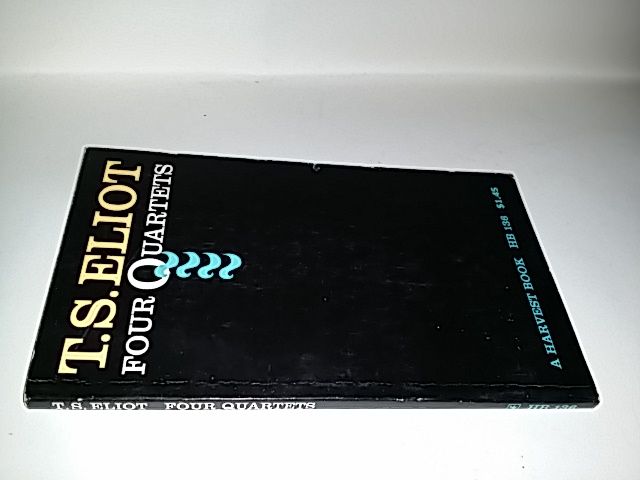
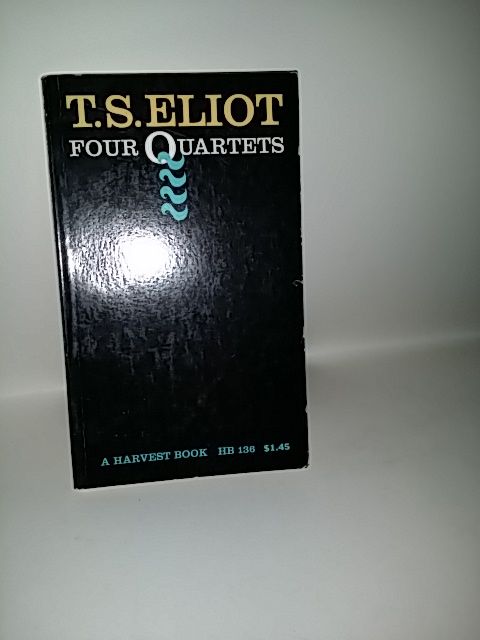
Four Quartets: Burnt Norton, East Coker, the Dry Savages, Little Gidding Trade paper - 1971

by T. S. Eliot

Add to wish list
  • Used
  • Good
  • Paperback
Used - Good

Description

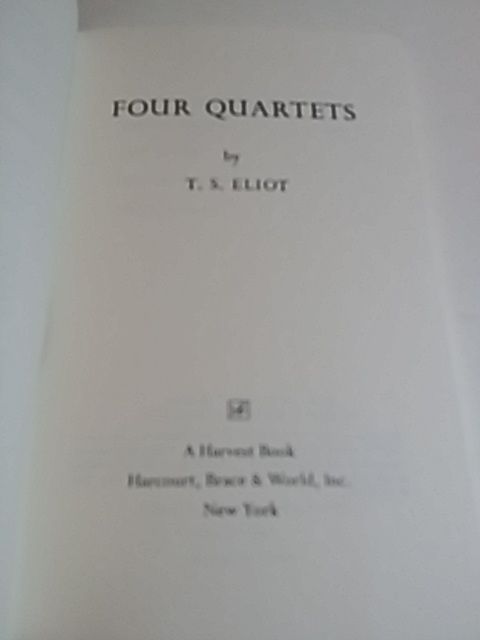
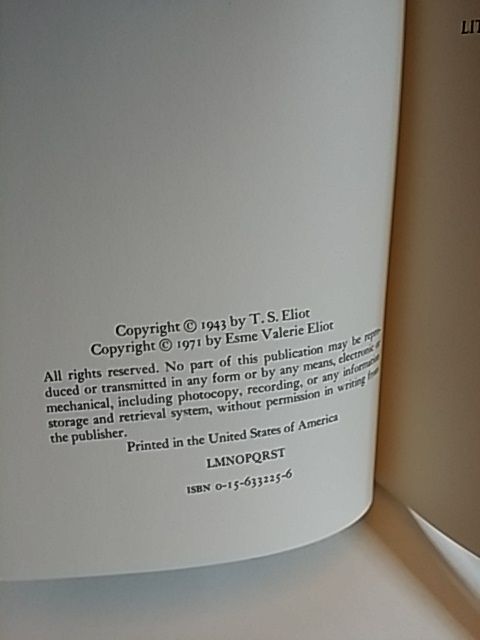
New York: a harvest book Harcourt, brace and world Inc., after last copyright 1971. later printing. Trade Paper. Good. copyright 1943 by T.S. Eliot copyright 1971 byEsme Valerie Eliot Four Quartets A Harvest/HBJ book Author Thomas Stearns Eliot Edition reprint Publisher Harcourt, Brace, 1943 ISBN 0156332256, 9780156332255 Length 39 pages Subjects Poetry American General Poetry / American / General Poetry / European / English, Irish, Scottish, Welsh T. S. Eliot is considered by many to be a literary genius and one of the most influential men of letters during the half-century after World War I. He was born on September 26, 1888, in St. Louis, Missouri. Eliot attended Harvard University, with time abroad pursuing graduate studies at the Sorbonne, Marburg, and Oxford. The outbreak of World War I prevented his return to the United States, and, persuaded by Ezra Pound to remain in England, he decided to settle there permanently. He published his influential early criticism, much of it written as occasional pieces for literary periodicals. He developed such doctrines as the "dissociation of sensibility" and the "objective correlative" and elaborated his views on wit and on the relation of tradition to the individual talent. Eliot by this time had left his early, derivative verse far behind and had begun to publish avant-garde poetry (including "The Love Song of J. Alfred Prufrock" (1915), which exploited fresh rhythms, abrupt juxtapositions, contemporary subject matter, and witty allusion. This period of creativity also resulted in another collection of verse (including "Gerontian") and culminated in The Waste Land, a masterpiece published in 1922 and produced partly during a period of psychological breakdown while married to his wife, Vivienne Haigh-Wood Eliot. In 1922, Eliot became a director of the Faber & Faber publishing house, and in 1927 he became a British citizen and joined the Church of England. Thereafter, his career underwent a change. With the publication of Ash Wednesday in 1930, his poetry became more overtly Christian. As editor of the influential literary magazine The Criterion, he turned his hand to social as well as literary criticism, with an increasingly conservative orientation. His religious poetry culminated in Four Quartets, published individually from 1936 onward and collectively in 1943. This work is often considered to be his greatest poetic achievement. Eliot also wrote poetry in a much lighter vein, such as Old Possum's Book of Practical Cats (1939), a collection that was used during the early 1980s as the basis for the musical, Cats. In addition to his contributions in poetry and criticism, Eliot is the pivotal verse dramatist of this century. He followed the lead of William Butler Yeats in attempting to revive metrical language in the theater. But, unlike Yeats, Eliot wanted a dramatic verse that would be self-effacing, capable of expressing the most prosaic passages in a play, and an insistent, undetected presence capable of elevating itself at a moment's notice. His progression from the pageant The Rock (1934) and Murder in the Cathedral (1935), written for the Canterbury Festival, through The Family Reunion (1939) and The Cocktail Party (1949), a West End hit, was thus a matter of neutralizing obvious poetic effects and bringing prose passages into the flow of verse. Recent critics have seen Eliot as a divided figure, covertly attracted to the very elements (romanticism, personality, heresy) he overtly condemned. His early attacks on romantic poets, for example, often reveal him as a romantic against the grain. The same divisions carry over into his verse, where violence struggles against restraint, emotion against order, and imagination against ironic detachment. This Eliot is more human and more attractive to contemporary taste. During his lifetime, Eliot received many honors and awards, including the Nobel Prize for literature in 1948......Used books are the "green" way to read and reduce your carbon footprint, we also try to reuse packing materials whenever possible keeping them out of landfills sooner rather than later..
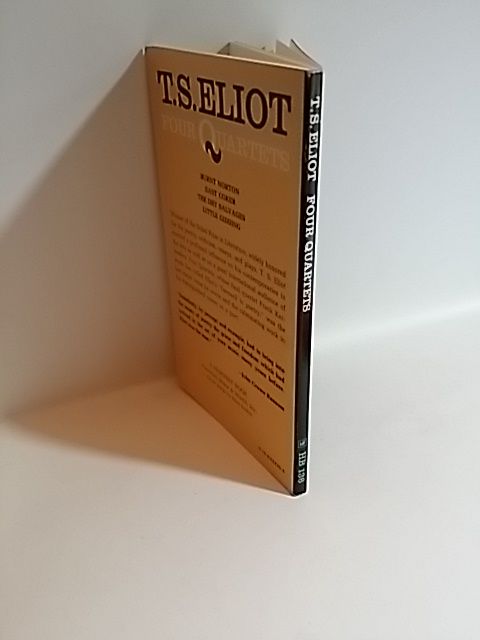
see pictures maybe this will do it maybe it won't. you'll know by looking at the pictures -Expedited Shipping available-by request/ price adjust-..Ruth Reaser..LAX Vespa shipped -United States Post to fulfill your order, Los Angeles I carefully pack your book,hop on my Vespa visit the PO to have it placed in our mail system.. your books wrapped,not co-mingled,you get the copy you were viewing. Carefully packed..
INv N / I
Ask the seller a question Add to wish list
A$27.97
A$15.94 Delivery within USA
Standard delivery: 7 to 14 days
More delivery options
Ships from Ruth Reaser LAXVESPA (California, United States)

Details

  • Title Four Quartets
  • Author T. S. Eliot
  • Binding Paperback
  • Edition later printing
  • Condition Used - Good
  • Pages 59
  • Volumes 1
  • Language ENG
  • Publisher a harvest book Harcourt, brace and world Inc., New York
  • Publication date after last copyright 1971
  • Features Table of Contents
  • Bookseller's Inventory # 943
  • ISBN 9780156332255 / 0156332256
  • Weight 0.19 lbs (0.09 kg)
  • Dimensions 7.99 x 5.28 x 0.2 in (20.29 x 13.41 x 0.51 cm)
  • Age range 14 to UP years
  • Grade levels 9 - UP
  • Themes
    • Cultural Region: British
    • Religious Orientation: Christian
    • Theometrics: Secular
  • Category Poetry
  • Dewey Decimal Code 821.912
  • Quantity available 1

About Ruth Reaser LAXVESPA California, United States

Biblio member since 2013

Small independent business,located in the Los Angeles area,

Terms of Sale: 30 day return guarantee, with full refund including original shipping costs for up to 30 days after delivery if an item arrives misdescribed or damaged.

Browse books from Ruth Reaser LAXVESPA

Summary

The last major verse written by Nobel laureate T. S. Eliot, considered by Eliot himself to be his finest work


Four Quartets is a rich composition that expands the spiritual vision introduced in “The Waste Land.” Here, in four linked poems (“Burnt Norton,” “East Coker,” “The Dry Salvages,” and “Little Gidding”), spiritual, philosophical, and personal themes emerge through symbolic allusions and literary and religious references from both Eastern and Western thought. It is the culminating achievement by a man considered the greatest poet of the twentieth century and one of the seminal figures in the evolution of modernism.

Reader reviews for Four Quartets

From the publisher

The celebrated, last major verse written by Nobel laureate T. S. Eliot.

Considered by Eliot himself to be his finest work, Four Quartets is a rich composition that expands the spiritual vision introduced in "The Waste Land." Here, in four linked poems ("Burnt Norton," "East Coker," "The Dry Salvages," and "Little Gidding"), spiritual, philosophical, and personal themes emerge through symbolic allusions and literary and religious references from both Eastern and Western thought. It is the culminating achievement by a man considered the greatest poet of the twentieth century and one of the seminal figures in the evolution of modernism.

Media reviews

Citations

  • Christianity Today, 03/01/2013, Page 54
  • Newsweek, 03/03/2008, Page 14
tracking-