BIBLIO is the largest independent book marketplace in the world, with over 100 million books.

Skip to content

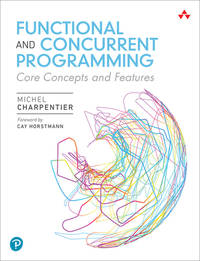
Functional and Concurrent Programming: Core Concepts and Features

Functional and Concurrent Programming: Core Concepts and Features

Functional and Concurrent Programming: Core Concepts and Features
Stock photo: cover may vary

Functional and Concurrent Programming: Core Concepts and Features Paperback -

by Charpentier, Michel

Add to wish list
  • New
New

Description

new.
Ask the seller a question Add to wish list
A$109.42
A$5.84 Delivery within USA
Standard delivery: 2 to 14 days
More delivery options
Ships from GreatBookPrices (Maryland, United States)

Details

  • Title Functional and Concurrent Programming: Core Concepts and Features
  • Author Charpentier, Michel
  • Binding Paperback
  • Condition New
  • Pages 528
  • Volumes 1
  • Language ENG
  • Publisher Addison-Wesley Professional
  • Features Glossary
  • Bookseller's Inventory # 43692703-n
  • ISBN 9780137466542 / 0137466544
  • Weight 1.62 lbs (0.73 kg)
  • Dimensions 9.14 x 7.06 x 0.74 in (23.22 x 17.93 x 1.88 cm)
  • Category Computers - Languages / Programming
  • Quantity available 5

About GreatBookPrices Maryland, United States

Biblio member since 2024

Since 1991, we have worked every day to serve our customers with state-of-the-art technology and world class service. We are dedicated to providing customers around the world with the widest selection of books, DVDs, and CDs at the absolute lowest price.

Terms of Sale: 30 day return guarantee, with full refund including original shipping costs for up to 30 days after delivery if an item arrives misdescribed or damaged.

Browse books from GreatBookPrices

Reader reviews for Functional and Concurrent Programming: Core Concepts and Features

From the publisher

Leverage Modern Language Constructs to Write High-Quality Code Faster

The functional and concurrent programming language features supported by modern languages can be challenging, even for experienced developers. These features may appear intimidating to OOP programmers because of a misunderstanding of how they work. Programmers first need to become familiar with the abstract concepts that underlie these powerful features.

In Functional and Concurrent Programming, Michel Charpentier introduces a core set of programming language constructs that will help you be productive in a variety of programming languages--now and in the future. Charpentier illustrates key concepts with numerous small, focused code examples, written in Scala, and with case studies that provide a thorough grounding in functional and concurrent programming skills. These skills will carry from language to language--including the most recent incarnations of Java. Using these features will enable developers and programmers to write high-quality code that is easier to understand, debug, optimize, and evolve.

Key topics covered include:

  • Recursion and tail recursion
  • Pattern matching and algebraic datatypes
  • Persistent structures and immutability
  • Higher-order functions and lambda expressions
  • Lazy evaluation and streams
  • Threads and thread pools
  • Atomicity and locking
  • Synchronization and thread-safe objects
  • Lock-free, non-blocking patterns
  • Futures, promises, and functional-concurrent programming


As a bonus, the book includes a discussion of common typing strategies used in modern programming languages, including type inference, subtyping, polymorphism, type classes, type bounds, and type variance.

Most of the code examples are in Scala, which includes many of the standard features of functional and concurrent programming; however, no prior knowledge of Scala is assumed. You should be familiar with concepts such as classes, methods, objects, types, variables, loops, and conditionals and have enough programming experience to not be distracted by simple matters of syntax.

About the author

Michel Charpentier is an associate professor with the Computer Science department at the University of New Hampshire (UNH). His interests over the years have ranged from distributed systems to formal verification and mobile sensor networks. He has been with UNH since 1999 and currently teaches courses in programming languages, concurrency, formal verification, and model-checking.

tracking-