
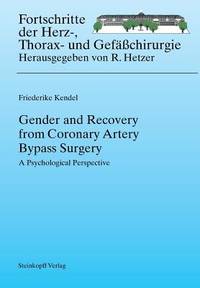
Stock photo: cover may vary
Gender Differences in Mortality and Physical Functioning After Coronary Artery Bypass Graft Surgery: An Analysis from a Psychosocial Perspective Paperback - 2008 - 1st Edition
by Kendel, Friederike
- New
- Paperback
A$126.03
A$28.98
Delivery to USA
Standard delivery: 7 to 14 days
More delivery options
Standard delivery: 7 to 14 days
Ships from Revaluation Books (Devon, United Kingdom)
Details
- Title Gender Differences in Mortality and Physical Functioning After Coronary Artery Bypass Graft Surgery: An Analysis from a Psychosocial Perspective
- Author Kendel, Friederike
- Binding Paperback
- Edition number 1st
- Edition 1
- Condition New
- Pages 104
- Volumes 1
- Language ENG
- Publisher Steinkopff Darmstadt
- Publication date 2008
- Bookseller's Inventory # x-3798518556
- ISBN 9783798518551 / 3798518556
- Weight 0.5 lbs (0.23 kg)
- Dimensions 9.4 x 6.5 x 0.3 in (23.88 x 16.51 x 0.76 cm)
-
Themes
- Aspects (Academic): Clinical (Medicine)
- Category Science
- Dewey Decimal Code 617.412
- Quantity available 2
About Revaluation Books Devon, United Kingdom
Biblio member since 2020
General bookseller of both fiction and non-fiction.
Reader reviews for Gender Differences in Mortality and Physical Functioning After Coronary Artery Bypass Graft Surgery: An Analysis from a Psychosocial Perspective
Write a review for this book
Important Terms and Guidelines
- Please focus on the book’s content and context. Also, add any personal comments as to how you enjoyed the book. Substantiate your likes and dislikes. You may make comparisons to other books.
- Reviews must be at least 140 characters in length.
- Please do not reveal critical plot elements.
- This is not a help line. Contact customer support if you need help.
Your review must not include:
- Obscenities, discriminatory language, or other insulting language not suitable for public domain
- Advertisements, “spam” content, or references to other products, offers or websites.
- Email addresses, URLs, phone numbers, physical addresses or other contact information.
- Overly critical comments about other reviews or reviewers
- Time-sensitive material (i.e. promotional tours, seminars, lectures, etc.)
- Availability, price, or alternative ordering/shipping information
From the publisher
From the rear cover
The number of coronary artery bypass graft (CABG) operations has increased continually over the past decade. To date, roughly one-third of these are performed on women. Despite the tremendous progress made in cardiovascular surgery, not all patients profit equally from it, and the mortality rate of women still exceeds that of men by a factor of two. Studies conducted to investigate this marked gender difference have yielded conflicting results. In particular, adjustment for clinical risk factors seemed to diminish the difference, but could not fully explain it.
Therefore psychosocial parameters, in particular depression and psychosocial stress, have gained increasing attention as predictors for both mortality and quality of life after CABG operation. Gender differences in these variables have long been observed in patients undergoing CABG: female patients are on average older, more often depressive and more often living alone than male patients. This book presents the very first German study to focus on these gender differences.
By describing the gender-specific influence of psychological and clinical variables on the recovery process, this work fills an important gap in cardiovascular research. Its approach is interdisciplinary in the best sense. The study underlines the importance of psychosocial variables for both mortality and quality of life in the context of CABG. Thus, it may be seen as a basis for a better understanding and treatment of CABG patients.

