
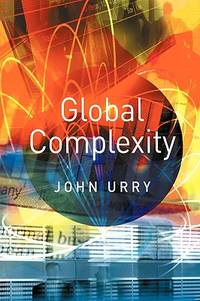
Stock photo: cover may vary
Global Complexity Hardback - - 1st Edition
by John Urry
- New
- Hardback
A$129.54
A$5.81
Delivery within USA
Standard delivery: 9 to 14 days
More delivery options
Standard delivery: 9 to 14 days
Ships from Cold Books (New York, United States)
Details
- Title Global Complexity
- Author John Urry
- Binding Hardback
- Edition number 1st
- Edition 1
- Condition New
- Pages 184
- Volumes 1
- Language ENG
- Publisher Polity Press
- Publication date pp. 184
- Illustrated Yes
- Features Bibliography, Illustrated, Index
- Bookseller's Inventory # 6361925
- ISBN 9780745628172 / 0745628176
- Weight 0.97 lbs (0.44 kg)
- Dimensions 9 x 6 x 0.56 in (22.86 x 15.24 x 1.42 cm)
- Category Sociology
- Library of Congress subjects Globalization, International relations
- Library of Congress Catalogue Number 2002072082
- Dewey Decimal Code 327.101
- Quantity available 3
About Cold Books New York, United States
Reader reviews for Global Complexity
Write a review for this book
Important Terms and Guidelines
- Please focus on the book’s content and context. Also, add any personal comments as to how you enjoyed the book. Substantiate your likes and dislikes. You may make comparisons to other books.
- Reviews must be at least 140 characters in length.
- Please do not reveal critical plot elements.
- This is not a help line. Contact customer support if you need help.
Your review must not include:
- Obscenities, discriminatory language, or other insulting language not suitable for public domain
- Advertisements, “spam” content, or references to other products, offers or websites.
- Email addresses, URLs, phone numbers, physical addresses or other contact information.
- Overly critical comments about other reviews or reviewers
- Time-sensitive material (i.e. promotional tours, seminars, lectures, etc.)
- Availability, price, or alternative ordering/shipping information
From the publisher
First line
HASH(0x1113fa10)
From the rear cover
Global Complexity is a path-breaking book, which examines how the ideas of chaos and complexity can help us to analyse global processes. Urry argues that there are major advantages in thinking about global processes in this way. The idea of complexity emphasizes that systems are balanced between order and chaos, that a system does not necessarily move towards equilibrium and that events are both unpredictable and irreversible in their effects. Hence specific events can have unexpected effects, often distant in time and space from where they occurred.
This book combines new theory with many illustrations of how global processes operate. Urry distinguishes between 'global networks' and 'global fluids', and shows how forms of global emergence develop from the complex relationships between these networks and fluids. He draws out the implications of global complexity for our understanding of social order and argues that complexity requires us to reformulate the main categories of sociology and to reject any globalization thesis that is over-unified, dominant and unambiguous in its effects. Global systems are always 'on the edge of chaos'.
This book will be of particular interest to students and scholars of sociology, politics, geography and economics and to and to all those concerned with rethinking the nature of globalization.

