BIBLIO is the largest independent book marketplace in the world, with over 100 million books.

Skip to content

Greens Function Integral Equation Methods In Nano Optics (Hb 2019)

Greens Function Integral Equation Methods In Nano Optics (Hb 2019)

Greens Function Integral Equation Methods In Nano Optics (Hb 2019)
Stock photo: cover may vary

Greens Function Integral Equation Methods In Nano Optics (Hb 2019)

by Sondergaard T M

Add to wish list
  • New
New

Description

new.
Ask the seller a question Add to wish list
A$388.85
A$5.82 Delivery within USA
Standard delivery: 2 to 14 days
More delivery options
Ships from GreatBookPrices (Maryland, United States)

Details

About GreatBookPrices Maryland, United States

Biblio member since 2024

Since 1991, we have worked every day to serve our customers with state-of-the-art technology and world class service. We are dedicated to providing customers around the world with the widest selection of books, DVDs, and CDs at the absolute lowest price.

Terms of Sale: 30 day return guarantee, with full refund including original shipping costs for up to 30 days after delivery if an item arrives misdescribed or damaged.

Browse books from GreatBookPrices

Reader reviews for Greens Function Integral Equation Methods In Nano Optics (Hb 2019)

From the publisher

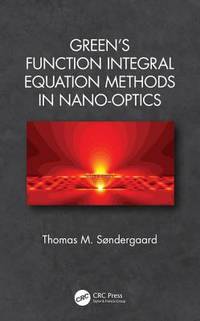
This book gives a comprehensive introduction to Green's function integral equation methods (GFIEMs) for scattering problems in the field of nano-optics. First, a brief review is given of the most important theoretical foundations from electromagnetics, optics, and scattering theory, including theory of waveguides, Fresnel reflection, and scattering, extinction, and absorption cross sections. This is followed by a presentation of different types of GFIEMs of increasing complexity for one-, two-, and three-dimensional scattering problems. In GFIEMs, the electromagnetic field at any position is directly related to the field at either the inside or the surface of a scattering object placed in a reference structure. The properties of the reference structure, and radiating or periodic boundary conditions, are automatically taken care of via the choice of Green's function. This book discusses in detail how to solve the integral equations using either simple or higher-order finite-element-based methods; how to calculate the relevant Green's function for different reference structures and choices of boundary conditions; and how to calculate near-fields, optical cross sections, and the power emitted by a local source. Solution strategies for large structures are discussed based on either transfer-matrix-approaches or the conjugate gradient algorithm combined with the Fast Fourier Transform. Special attention is given to reducing the computational problem for three-dimensional structures with cylindrical symmetry by using cylindrical harmonic expansions.

Each presented method is accompanied by examples from nano-optics, including: resonant metal nano-particles placed in a homogeneous medium or on a surface or waveguide; a microstructured gradient-index-lens; the Purcell effect for an emitter in a photonic crystal; the excitation of surface plasmon polaritons by second-harmonic generation in a polymer fiber placed on a thin metal film; and anti-reflective, broadband absorbing or resonant surface microstructures. Each presented method is also accompanied by guidelines for software implementation and exercises.

Features

  • Comprehensive introduction to Green's function integral equation methods for scattering problems in the field of nano-optics
  • Detailed explanation of how to discretize and solve integral equations using simple and higher-order finite-element approaches
  • Solution strategies for large structures
  • Guidelines for software implementation and exercises
  • Broad selection of examples of scattering problems in nano-optics

About the author

Dr. Thomas Sndergaard is currently an Associate Professor in Nano Optics, Aalborg University, Denmark. His areas of expertise include numerical methods for theoretical analysis of electromagnetic fields in micro- and nanostructures. Plasmonics: waveguiding, optical antennas, resonators and sensors based on a type of electromagnetic surface wave at metal-dielectric interfaces known as Surface Plasmon Polaritons. Photonic crystals: wavelength-scale periodic structures in which light with certain wavelengths cannot propagate, similar to electrons with certain energies not being able to progagate in semiconductors, and how this can be exploited for e.g. designing optical waveguides and cavities. Green's function integral equation methods. Dr. Sondergaard has been awarded The Danish Independent Research Councils' Young Researcher's Award (2006) and The Danish Optical Society Award (2008). He is a board member of the Danish Optical Society and reviewer of 15-20 papers per year for such journals as Physical Review B, Physical Review Letters, Applied Physics Letters, Optics Express, IEEE Journal of Quantum Electronics, IEEE Journal of Lightwave Technology, Optics Communications, Physica status solidi (b), Nature Photonics, Optics Letters, and Journal of the Optical Society of America A/B. Dr. Sondergaard has also been published 84 papers in peerreviewed journals and holds three patents.

tracking-