
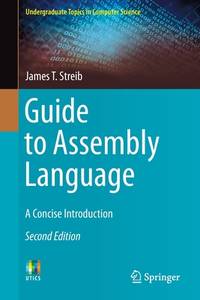
Stock photo: cover may vary
GUIDE TO ASSEMBLY LANGUAGE Paperback - 2020
by James T. Streib
- New
A$83.04
A$21.59
Delivery to USA
Standard delivery: 7 to 14 days
More delivery options
Standard delivery: 7 to 14 days
Details
- Title GUIDE TO ASSEMBLY LANGUAGE
- Author James T. Streib
- Binding Paperback
- Condition New
- Pages 344
- Volumes 1
- Language ENG
- Publisher Springer
- Publication date 2020-01-24
- Illustrated Yes
- Features Glossary, Illustrated
- Bookseller's Inventory # BIBNN-277355
- ISBN 9783030356385 / 3030356388
- Weight 1.12 lbs (0.51 kg)
- Dimensions 9.21 x 6.14 x 0.75 in (23.39 x 15.60 x 1.91 cm)
- Category Computers - Languages / Programming
- Quantity available 1
About Students Textbooks India
Specialising in: International Edition., Textbooks
Biblio member since 2009
Selling textbooks, International editions and reference books online from last 5 Years.
30 day return guarantee, with full refund including shipping costs for up to 30 days after delivery if an item arrives misdescribed or damaged. Return address: Students_Textbooks 12 phankha road Jankpuri New Delhi 110036 India
Reader reviews for GUIDE TO ASSEMBLY LANGUAGE
Write a review for this book
Important Terms and Guidelines
- Please focus on the book’s content and context. Also, add any personal comments as to how you enjoyed the book. Substantiate your likes and dislikes. You may make comparisons to other books.
- Reviews must be at least 140 characters in length.
- Please do not reveal critical plot elements.
- This is not a help line. Contact customer support if you need help.
Your review must not include:
- Obscenities, discriminatory language, or other insulting language not suitable for public domain
- Advertisements, “spam” content, or references to other products, offers or websites.
- Email addresses, URLs, phone numbers, physical addresses or other contact information.
- Overly critical comments about other reviews or reviewers
- Time-sensitive material (i.e. promotional tours, seminars, lectures, etc.)
- Availability, price, or alternative ordering/shipping information
From the publisher
From the rear cover
This concise guide is designed to enable the reader to learn how to program in assembly language as quickly as possible. Through a hands-on programming approach, readers will also learn about the architecture of the Intel processor, and the relationship between high-level and low-level languages.
This updated second edition has been expanded with additional exercises, and enhanced with new material on floating-point numbers and 64-bit processing.
Topics and features:
- Provides guidance on simplified register usage, simplified input/output using C-like statements, and the use of high-level control structures
- Describes the implementation of control structures, without the use of high-level structures, and often with related C program code
- Illustrates concepts with one or more complete program
- Presents review summaries in each chapter, together with a variety of exercises, from short-answer questions to programming assignments
- Covers selection and iteration structures, logic, shift, arithmetic shift, rotate, and stack instructions, procedures and macros, arrays, and strings
- Includes an introduction to floating-point instructions and 64-bit processing
- Examines machine language from a discovery perspective, introducing the principles of computer organization
A must-have resource for undergraduate students seeking to learn the fundamentals necessary to begin writing logically correct programs in a minimal amount of time, this work will serve as an ideal textbook for an assembly language course, or as a supplementary text for courses on computer organization and architecture. The presentation assumes prior knowledge of the basics of programming in a high-level language such as C, C++, or Java.
Dr. James T. Streib is Professor Emeritus of Computer Science at Illinois College, Jacksonville, IL, USA. His other publications include the Springer textbooks Guide to Data Structures and Guide to Java.

