
Stock photo: cover may vary
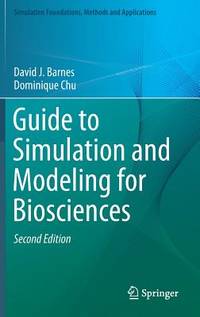
Guide to Simulation and Modeling for Biosciences (Simulation Foundations, Methods and Applications) Hardback -
by David J. Barnes; Dominique Chu
- New
- Hardback
A$140.50
A$5.76
Delivery within USA
Standard delivery: 9 to 14 days
More delivery options
Standard delivery: 9 to 14 days
Ships from Cold Books (New York, United States)
Details
- Title Guide to Simulation and Modeling for Biosciences (Simulation Foundations, Methods and Applications)
- Author David J. Barnes; Dominique Chu
- Binding Hardback
- Condition New
- Pages 339
- Volumes 1
- Language ENG
- Publisher Springer
- Publication date pp. 339
- Illustrated Yes
- Features Illustrated
- Bookseller's Inventory # 6372771763
- ISBN 9781447167617 / 1447167619
- Weight 1.47 lbs (0.67 kg)
- Dimensions 9.21 x 6.14 x 0.81 in (23.39 x 15.60 x 2.06 cm)
- Category Computers - General Information
- Dewey Decimal Code 003.3
- Quantity available 4
About Cold Books New York, United States
Reader reviews for Guide to Simulation and Modeling for Biosciences (Simulation Foundations, Methods and Applications)
Write a review for this book
Important Terms and Guidelines
- Please focus on the book’s content and context. Also, add any personal comments as to how you enjoyed the book. Substantiate your likes and dislikes. You may make comparisons to other books.
- Reviews must be at least 140 characters in length.
- Please do not reveal critical plot elements.
- This is not a help line. Contact customer support if you need help.
Your review must not include:
- Obscenities, discriminatory language, or other insulting language not suitable for public domain
- Advertisements, “spam” content, or references to other products, offers or websites.
- Email addresses, URLs, phone numbers, physical addresses or other contact information.
- Overly critical comments about other reviews or reviewers
- Time-sensitive material (i.e. promotional tours, seminars, lectures, etc.)
- Availability, price, or alternative ordering/shipping information
From the publisher
From the rear cover
This accessible text/reference presents a detailed introduction to the use of a wide range of software tools and modeling environments for use in the biosciences, as well as some of the fundamental mathematical background. The practical constraints and difficulties presented by each modeling technique are described in detail, enabling the researcher to determine quickly which software package would be most useful for their particular problem.
This Guide to Simulation and Modeling for Biosciences is a fully updated and enhanced revision of the authors' earlier Introduction to Modeling for Biosciences. Written with the particular needs of the novice modeler in mind, this unique and helpful work guides the reader through realistic and concrete modeling projects, highlighting and commenting on the process of abstracting the real system into a model.
Topics and features:
- Introduces a basic array of techniques to formulate models of biological systems, and to solve them
- Discusses agent-based models, stochastic modeling techniques, differential equations, spatial simulations, and Gillespie's stochastic simulation algorithm
- Provides exercises to help the reader sharpen their understanding of the topics
- Describes such useful tools as the Maxima algebra system, the PRISM model checker, and the modeling environments Repast Simphony and Smoldyn
- Contains appendices on rules of differentiation and integration, Maxima and PRISM notation, and some additional mathematical concepts
- Offers supplementary material at an associated website,
Students and active researchers in the biosciences will benefit from the discussions of the high-quality, tried-and-tested modeling tools described in the book, as well as the thorough descriptions and examples.

