BIBLIO is the largest independent book marketplace in the world, with over 100 million books.

Skip to content

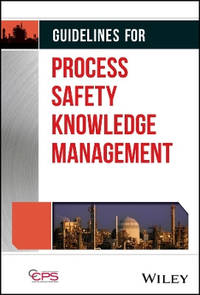
Guidelines for Process Safety Knowledge Management

Guidelines for Process Safety Knowledge Management

Guidelines for Process Safety Knowledge Management Hardback -

by CCPS (Center for Chemical Process Safety)

Add to wish list
  • New
  • Hardback
New

Description

Hardback. New.

Use this guideline to develop an effective Process Safety Knowledge Management system

When managing the risks of hazardous materials and energies, a well-developed process safety program is critical for maintaining a healthy workforce, for protecting the environment, and for sustaining the business. The Center for Chemical Process Safety (CCPS) has identified Process Knowledge Management as one of its twenty Elements in its Risk Based Process Safety (RBPS) approach. With an effective Process Safety Knowledge Management (PSKM) system, an organization will be able to capture, organize, maintain, and access its technical, engineering, and administrative information. Thus, an effective PSKM system will help an organization successfully manage its risks.

This book provides a set of comprehensive guidelines for implementing a Process Safety Knowledge Management (PSKM) system, which will help an organization improve its process safety performance. The book begins with a discussion on the characteristics of a PSKM system. Then it describes the underlying factors for successful implementation and ends with guidance on overcoming common implementation difficulties. Produced by a leading global process safety organization, this book is essential for any organization looking to ensure that systems are in place to sustain their process safety knowledge during the life of the process.

Guidelines for Process Safety Knowledge Management readers will also find:

  • Case studies throughout the book, with PSKM-related lessons
  • Detailed discussions of how a PSKM system helps cultivate leadership, improves organizational culture, and involves employees
  • A business case for PSKM, demonstrating the benefits to the business

Guidelines for Process Safety Knowledge Management is ideal for process safety professionals, engineering managers, facility managers, maintenance managers, production managers, and others responsible for creating or managing their process safety knowledge management systems.

Ask the seller a question Add to wish list
A$221.06
A$19.43 Delivery to USA
Standard delivery: 14 to 21 days
More delivery options
Ships from The Saint Bookstore (Merseyside, United Kingdom)

Details

  • Title Guidelines for Process Safety Knowledge Management
  • Author CCPS (Center for Chemical Process Safety)
  • Binding Hardback
  • Condition New
  • Pages 224
  • Volumes 1
  • Language ENG
  • Publisher Wiley-Aiche
  • Features Bibliography, Glossary, Index
  • Bookseller's Inventory # A9781394187713
  • ISBN 9781394187713 / 1394187718
  • Weight 1.03 lbs (0.47 kg)
  • Dimensions 9.06 x 6.19 x 0.63 in (23.01 x 15.72 x 1.60 cm)
  • Category Technology & Industrial Arts
  • Library of Congress subjects Industrial safety, Knowledge management
  • Library of Congress Catalogue Number 2024037119
  • Dewey Decimal Code 658.408
  • Quantity available 10

About The Saint Bookstore Merseyside, United Kingdom

Biblio member since 2018

The Saint Bookstore specialises in hard to find titles & also offers delivery worldwide for reasonable rates.

Terms of Sale: Refunds or Returns: A full refund of the price paid will be given if returned within 30 days in undamaged condition. If the product is faulty, we may send a replacement.

Browse books from The Saint Bookstore

Reader reviews for Guidelines for Process Safety Knowledge Management

From the publisher

Use this guideline to develop an effective Process Safety Knowledge Management system

When managing the risks of hazardous materials and energies, a well-developed process safety program is critical for maintaining a healthy workforce, for protecting the environment, and for sustaining the business. The Center for Chemical Process Safety (CCPS) has identified Process Knowledge Management as one of its twenty Elements in its Risk Based Process Safety (RBPS) approach. With an effective Process Safety Knowledge Management (PSKM) system, an organization will be able to capture, organize, maintain, and access its technical, engineering, and administrative information. Thus, an effective PSKM system will help an organization successfully manage its risks.

This book provides a set of comprehensive guidelines for implementing a Process Safety Knowledge Management (PSKM) system, which will help an organization improve its process safety performance. The book begins with a discussion on the characteristics of a PSKM system. Then it describes the underlying factors for successful implementation and ends with guidance on overcoming common implementation difficulties. Produced by a leading global process safety organization, this book is essential for any organization looking to ensure that systems are in place to sustain their process safety knowledge during the life of the process.

Guidelines for Process Safety Knowledge Management readers will also find:

  • Case studies throughout the book, with PSKM-related lessons
  • Detailed discussions of how a PSKM system helps cultivate leadership, improves organizational culture, and involves employees
  • A business case for PSKM, demonstrating the benefits to the business

Guidelines for Process Safety Knowledge Management is ideal for process safety professionals, engineering managers, facility managers, maintenance managers, production managers, and others responsible for creating or managing their process safety knowledge management systems.

About the author

Center for Chemical Process Safety (CCPS) is the world leader in developing and disseminating information on process safety technologies and management systems since 1985. An industry technology alliance of the American Institute of Chemical Engineers (AIChE), CCPS has published over 100 books in its process safety guidelines and key concepts series. It is supported by the contributions and voluntary participation of more than 250 companies worldwide.

tracking-