
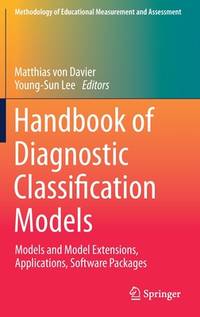
Stock photo: cover may vary
Handbook of Diagnostic Classification Models: Models and Model Extensions, Applications, Software Packages (Methodology of Educational Measurement and Assessment) Hardback - 2019
by von Davier, Matthias
- Used
- Hardback
- first
A$513.71
A$21.74
Delivery within USA
Standard delivery: 12 to 14 days
More delivery options
Standard delivery: 12 to 14 days
Dropship order
Ships from Ergodebooks (Texas, United States)
Details
- Title Handbook of Diagnostic Classification Models: Models and Model Extensions, Applications, Software Packages (Methodology of Educational Measurement and Assessment)
- Author von Davier, Matthias
- Binding Hardback
- Edition 1st ed. 2019
- Condition Used: Good
- Pages 656
- Volumes 1
- Language ENG
- Publisher Springer
- Publication date 2019-08-31
- Illustrated Yes
- Features Illustrated
- Bookseller's Inventory # SONG3030055833
- ISBN 9783030055837 / 3030055833
- Weight 2.45 lbs (1.11 kg)
- Dimensions 9.21 x 6.14 x 1.44 in (23.39 x 15.60 x 3.66 cm)
- Size 6.25x1.50x9.25
- Category Education / Teaching
- Dewey Decimal Code 150.151
- Quantity available 1
About Ergodebooks Texas, United States
Biblio member since 2005
Our goal is to provide best customer service and good condition books for the lowest possible price. We are always honest about condition of book. We list book only by ISBN # and hence exact book is guaranteed.
We have 30 day return policy.
Reader reviews for Handbook of Diagnostic Classification Models: Models and Model Extensions, Applications, Software Packages (Methodology of Educational Measurement and Assessment)
Write a review for this book
Important Terms and Guidelines
- Please focus on the book’s content and context. Also, add any personal comments as to how you enjoyed the book. Substantiate your likes and dislikes. You may make comparisons to other books.
- Reviews must be at least 140 characters in length.
- Please do not reveal critical plot elements.
- This is not a help line. Contact customer support if you need help.
Your review must not include:
- Obscenities, discriminatory language, or other insulting language not suitable for public domain
- Advertisements, “spam” content, or references to other products, offers or websites.
- Email addresses, URLs, phone numbers, physical addresses or other contact information.
- Overly critical comments about other reviews or reviewers
- Time-sensitive material (i.e. promotional tours, seminars, lectures, etc.)
- Availability, price, or alternative ordering/shipping information
From the publisher
From the rear cover
This handbook provides an overview of major developments around diagnostic classification models (DCMs) with regard to modeling, estimation, model checking, scoring, and applications. It brings together not only the current state of the art, but also the theoretical background and models developed for diagnostic classification. The handbook also offers applications and special topics and practical guidelines how to plan and conduct research studies with the help of DCMs. Commonly used models in educational measurement and psychometrics typically assume a single latent trait or at best a small number of latent variables that are aimed at describing individual differences in observed behavior. While this allows simple rankings of test takers along one or a few dimensions, it does not provide a detailed picture of strengths and weaknesses when assessing complex cognitive skills. DCMs, on the other hand, allow the evaluation of test taker performance relative to a potentiallylarge number of skill domains. Most diagnostic models provide a binary mastery/non-mastery classification for each of the assumed test taker attributes representing these skill domains. Attribute profiles can be used for formative decisions as well as for summative purposes, for example in a multiple cut-off procedure that requires mastery on at least a certain subset of skills. The number of DCMs discussed in the literature and applied to a variety of assessment data has been increasing over the past decades, and their appeal to researchers and practitioners alike continues to grow. These models have been used in English language assessment, international large scale assessments, and for feedback for practice exams in preparation of college admission testing, just to name a few. Nowadays, technology-based assessments provide increasingly rich data on a multitude of skills and allow collection of data with respect to multiple types of behaviors. Diagnostic models can be understood as an ideal match for these types of data collections to provide more in-depth information about test taker skills and behavioral tendencies.

