BIBLIO is the largest independent book marketplace in the world, with over 100 million books.

Skip to content

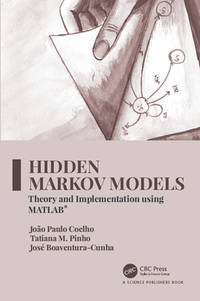
Hidden Markov Models: Theory and Implementation using MATLAB®

Hidden Markov Models: Theory and Implementation using MATLAB®

Hidden Markov Models: Theory and Implementation using MATLAB®
Stock photo: cover may vary

Hidden Markov Models: Theory and Implementation using MATLAB®

by Coelho, João Paulo; Pinho, Tatiana M.; Boaventura-Cunha, José

Add to wish list
  • New
New

Description

new.
Ask the seller a question Add to wish list
A$374.09
A$5.82 Delivery within USA
Standard delivery: 2 to 14 days
More delivery options
Ships from GreatBookPrices (Maryland, United States)

Details

About GreatBookPrices Maryland, United States

Biblio member since 2024

Since 1991, we have worked every day to serve our customers with state-of-the-art technology and world class service. We are dedicated to providing customers around the world with the widest selection of books, DVDs, and CDs at the absolute lowest price.

Terms of Sale: 30 day return guarantee, with full refund including original shipping costs for up to 30 days after delivery if an item arrives misdescribed or damaged.

Browse books from GreatBookPrices

Reader reviews for Hidden Markov Models: Theory and Implementation using MATLAB®

From the publisher

This book presents, in an integrated form, both the analysis and synthesis of three different types of hidden Markov models. Unlike other books on the subject, it is generic and does not focus on a specific theme, e.g. speech processing. Moreover, it presents the translation of hidden Markov models' concepts from the domain of formal mathematics into computer codes using MATLAB(R). The unique feature of this book is that the theoretical concepts are first presented using an intuition-based approach followed by the description of the fundamental algorithms behind hidden Markov models using MATLAB(R). This approach, by means of analysis followed by synthesis, is suitable for those who want to study the subject using a more empirical approach.

Key Selling Points:

  • Presents a broad range of concepts related to Hidden Markov Models (HMM), from simple problems to advanced theory
  • Covers the analysis of both continuous and discrete Markov chains
  • Discusses the translation of HMM concepts from the realm of formal mathematics into computer code
  • Offers many examples to supplement mathematical notation when explaining new concepts

Media reviews

Citations

  • Choice, 07/01/2020, Page 0

About the author

Joo Paulo Coelho is an adjunct professor, and currently the Electrical Engineering course director, at the Polytechnic Institute of Bragana. He is also a researcher at CeDRI and holds a Ph.D. degree in computational intelligence applied to agricultural greenhouses. He has been involved, as a researcher member, in several scientific projects at both the national and European level. His research interests include control systems design, machine learning, electronic instrumentation, embedded systems and discrete-event computer simulation.


Tatiana M. Pinho graduated in Energy Engineering from the University of Trs-os-Montes e Alto Douro (UTAD), Portugal in 2011 and received the MSc degree in Energy Engineering from UTAD in 2013. In 2018, she received the Ph.D. degree in Electrical and Computer Engineering in UTAD and INESC TEC Technology and Science, supported by the FCT. Presently she is a postdoctoral researcher at the INESC TEC and her research interests include systems' modeling and adaptive control.

Jos Boaventura-Cunha graduated in Electronics and Telecommunications Engineering and has a Ph.D. degree in Electrical and Computer Engineering. Presently he is an Associate Professor with habilitation at the UTAD University, a senior researcher at the INESC-TEC and member of IFAC and IEEE. He has coordinated/participated in several national and international research projects aiming the development of new instrumentation, modelling and control technologies applied to agriculture. His research interests include modeling, system identification and adaptive control.

tracking-