
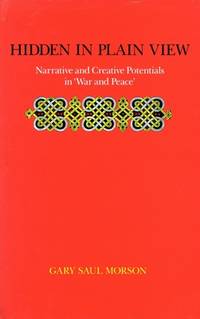
Stock photo: cover may vary
Hidden in Plain View: Narrative and Creative Potentials in ‘War and Peace’ Paperback - 1988 - 1st Edition
by Morson, Gary Saul
- New
- Paperback
A$126.80
A$8.53
Delivery within USA
Standard delivery: 2 to 21 days
More delivery options
Standard delivery: 2 to 21 days
Ships from GridFreed LLC (California, United States)
Details
- Title Hidden in Plain View: Narrative and Creative Potentials in ‘War and Peace’
- Author Morson, Gary Saul
- Binding Paperback
- Edition number 1st
- Edition 1
- Condition New
- Pages 336
- Volumes 1
- Language ENG
- Publisher Stanford University Press, Chicago, Illinois, U.S.A.
- Publication date 1988-12-01
- Features Bibliography, Index, Table of Contents
- Bookseller's Inventory # Q-0804717184
- ISBN 9780804717182 / 0804717184
- Weight 0.9 lbs (0.41 kg)
- Dimensions 8.4 x 5.4 x 0.9 in (21.34 x 13.72 x 2.29 cm)
-
Themes
- Cultural Region: Russian
- Category Literature - Classics / Criticism
- Dewey Decimal Code 891.733
- Quantity available 1
About GridFreed LLC California, United States
Biblio member since 2021
We sell primarily non-fiction, many new books, some collectible first editions and signed books. We operate 100% online and have been in business since 2005.
Reader reviews for Hidden in Plain View: Narrative and Creative Potentials in ‘War and Peace’
Write a review for this book
Important Terms and Guidelines
- Please focus on the book’s content and context. Also, add any personal comments as to how you enjoyed the book. Substantiate your likes and dislikes. You may make comparisons to other books.
- Reviews must be at least 140 characters in length.
- Please do not reveal critical plot elements.
- This is not a help line. Contact customer support if you need help.
Your review must not include:
- Obscenities, discriminatory language, or other insulting language not suitable for public domain
- Advertisements, “spam” content, or references to other products, offers or websites.
- Email addresses, URLs, phone numbers, physical addresses or other contact information.
- Overly critical comments about other reviews or reviewers
- Time-sensitive material (i.e. promotional tours, seminars, lectures, etc.)
- Availability, price, or alternative ordering/shipping information
From the publisher
From the jacket flap
For decades, the formal peculiarities of War and Peace disturbed Russian and Western critics, who attributed both the anomalous structure and the literary power of the book to Tolstoy's "primitive," unruly genius. Using that critical history as a starting point, this volume recaptures the overwhelming sense of strangeness felt by the work's first readers and thereby illuminates Tolstoy's theoretical and narratological concerns.
The author demonstrates that the formal peculiarities of War and Peace were deliberate, designed to elude what Tolstoy regarded as the falsifying constraints of all narratives, both novelistic and historical. Developing and challenging the ideas of Mikhail Bakhtin, Morson explores Tolstoy's account of the work's composition in light of various myths of the creative process. He proposes a theory of "creation by potential" that incorporates Tolstoy's main concerns: the "openness" of each historical moment; the role of chance in history and within narrative patterns; and the efficacy of ordinary events, "hidden in plain view," in shaping history and individual psychology. In his reading of Tolstoy, he demonstrates how we read literary works within the "penumbral text" of associated theories of creativity.
The author demonstrates that the formal peculiarities of War and Peace were deliberate, designed to elude what Tolstoy regarded as the falsifying constraints of all narratives, both novelistic and historical. Developing and challenging the ideas of Mikhail Bakhtin, Morson explores Tolstoy's account of the work's composition in light of various myths of the creative process. He proposes a theory of "creation by potential" that incorporates Tolstoy's main concerns: the "openness" of each historical moment; the role of chance in history and within narrative patterns; and the efficacy of ordinary events, "hidden in plain view," in shaping history and individual psychology. In his reading of Tolstoy, he demonstrates how we read literary works within the "penumbral text" of associated theories of creativity.

