
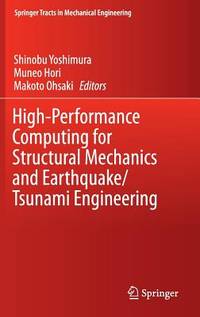
Stock photo: cover may vary
High Performance Computing For Structural Mechanics And Earthquake Tsunami Engineering (Hb 2016) Hardback - 2016 - 2016th Edition
by Yoshimura S
- New
A$377.07
A$21.49
Delivery to USA
Standard delivery: 20 to 30 days
More delivery options
Standard delivery: 20 to 30 days
Ships from BookVistas (Delhi, India)
Details
- Title High Performance Computing For Structural Mechanics And Earthquake Tsunami Engineering (Hb 2016)
- Author Yoshimura S
- Binding Hardback
- Edition number 2016th
- Edition 2016
- Condition New
- Pages 199
- Volumes 1
- Language ENG
- Publisher Springer
- Publication date 2016
- Illustrated Yes
- Features Illustrated
- Bookseller's Inventory # CBS-9783319210476
- ISBN 9783319210476 / 3319210475
- Weight 1.03 lbs (0.47 kg)
- Dimensions 9.21 x 6.14 x 0.5 in (23.39 x 15.60 x 1.27 cm)
- Category Science
- Dewey Decimal Code 003.3
- Quantity available 500
About BookVistas Delhi, India
Specialising in: Art, Archaeology & Architecture, Computers, History, Culture & Politics, Languages, Literature & Linguistics, Management, Music, Dance & Theatre, Religion & Philosophy, Science, Technology & Medicine
Biblio member since 2011
We are leading publishers, booksellers, distributors, importers, and exporters. We carry a large selection of books on varied subjects. Do place your valued order or let us know your requirement via email.
30 day return guarantee, with full refund including shipping costs for up to 30 days after delivery if an item arrives misdescribed or damaged.
�
Books are shipped by Registered Air Mail or DHL/FedEx/Aramex. Additional shipping charges may be required for multi-volume sets.
Reader reviews for High Performance Computing For Structural Mechanics And Earthquake Tsunami Engineering (Hb 2016)
Write a review for this book
Important Terms and Guidelines
- Please focus on the book’s content and context. Also, add any personal comments as to how you enjoyed the book. Substantiate your likes and dislikes. You may make comparisons to other books.
- Reviews must be at least 140 characters in length.
- Please do not reveal critical plot elements.
- This is not a help line. Contact customer support if you need help.
Your review must not include:
- Obscenities, discriminatory language, or other insulting language not suitable for public domain
- Advertisements, “spam” content, or references to other products, offers or websites.
- Email addresses, URLs, phone numbers, physical addresses or other contact information.
- Overly critical comments about other reviews or reviewers
- Time-sensitive material (i.e. promotional tours, seminars, lectures, etc.)
- Availability, price, or alternative ordering/shipping information
From the publisher
From the rear cover
Huge earthquakes and tsunamis have caused serious damage to important structures such as civil infrastructure elements, buildings and power plants around the globe. To quantitatively evaluate such damage processes and to design effective prevention and mitigation measures, the latest high-performance computational mechanics technologies, which include telascale to petascale computers, can offer powerful tools. The phenomena covered in this book include seismic wave propagation in the crust and soil, seismic response of infrastructure elements such as tunnels considering soil-structure interactions, seismic response of high-rise buildings, seismic response of nuclear power plants, tsunami run-up over coastal towns and tsunami inundation considering fluid-structure interactions. The book provides all necessary information for addressing these phenomena, ranging from the fundamentals of high-performance computing for finite element methods, key algorithms of accurate dynamic structural analysis, fluid flows with free surfaces, and fluid-structure interactions, to practical applications with detailed simulation results. The book will offer essential insights for researchers and engineers working in the field of computational seismic/tsunami engineering.

