
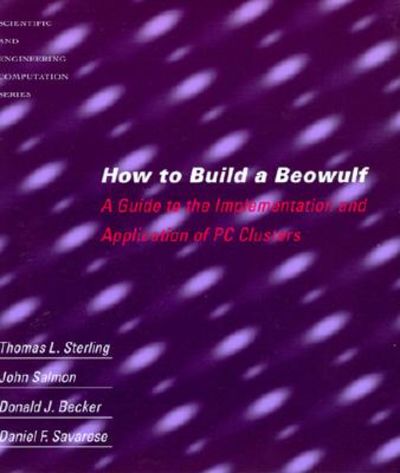
Stock photo: cover may vary
How to Build a Beowulf – A Guide to the Implementation & Application of PC Clusters Paperback - 1999
by Thomas Sterling, Donald J Becker, John Salmon et Daniel F Savarese
- Used
- very good
- Paperback
A$11.75
A$37.95
Delivery to USA
Standard delivery: 5 to 28 days
More delivery options
Standard delivery: 5 to 28 days
Details
- Title How to Build a Beowulf – A Guide to the Implementation & Application of PC Clusters
- Author Thomas Sterling, Donald J Becker, John Salmon et Daniel F Savarese
- Binding Paperback
- Edition N/A
- Condition Used - Very good
- Pages 262
- Volumes 1
- Language ENG
- Publisher MIT Press, Cambridge, MA; USA
- Publication date 1999
- Bookseller's Inventory # G-128-982
- ISBN 9780262692182 / 026269218X
- Weight 1.24 lbs (0.56 kg)
- Dimensions 9.03 x 7.99 x 0.73 in (22.94 x 20.29 x 1.85 cm)
- Age range 18 to UP years
- Grade levels 13 - UP
- Category Computers - General Information
- Library of Congress subjects Electronic data processing - Distributed, Parallel computers
- Library of Congress Catalogue Number 98-37596
- Dewey Decimal Code 004.36
- Quantity available 1
About AMMAREAL France
Biblio member since 2020
Ammareal is a professional bookseller specialized in used books. We ship worldwide. We have more than 1 million books in stock, including a large number of technical and university-level books. We give back up to 15% of the price of each book to charities, libraries and organizations fighting in favor of literacy. What we do not sell, we give ; what we do not give, we recycle.
Reader reviews for How to Build a Beowulf – A Guide to the Implementation & Application of PC Clusters
Write a review for this book
Important Terms and Guidelines
- Please focus on the book’s content and context. Also, add any personal comments as to how you enjoyed the book. Substantiate your likes and dislikes. You may make comparisons to other books.
- Reviews must be at least 140 characters in length.
- Please do not reveal critical plot elements.
- This is not a help line. Contact customer support if you need help.
Your review must not include:
- Obscenities, discriminatory language, or other insulting language not suitable for public domain
- Advertisements, “spam” content, or references to other products, offers or websites.
- Email addresses, URLs, phone numbers, physical addresses or other contact information.
- Overly critical comments about other reviews or reviewers
- Time-sensitive material (i.e. promotional tours, seminars, lectures, etc.)
- Availability, price, or alternative ordering/shipping information
From the publisher
First line
HASH(0x110d2620)

