
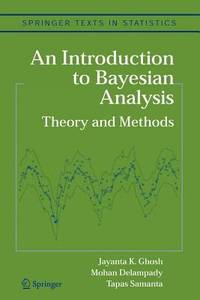
Stock photo: cover may vary
An Introduction to Bayesian Analysis Papeback -
by Tapas Samanta Jayanta K. Ghosh Mohan Delampady
- New
A$301.98
A$5.82
Delivery within USA
Standard delivery: 9 to 14 days
More delivery options
Standard delivery: 9 to 14 days
Ships from Cold Books (New York, United States)
Details
- Title An Introduction to Bayesian Analysis
- Author Tapas Samanta Jayanta K. Ghosh Mohan Delampady
- Binding Papeback
- Edition 1st edition
- Condition New
- Pages 354
- Volumes 1
- Language ENG
- Publisher Springer
- Publication date pp. 370
- Features Bibliography, Index, Table of Contents
- Bookseller's Inventory # 63070090
- ISBN 9781441923035 / 1441923039
- Weight 1.15 lbs (0.52 kg)
- Dimensions 9 x 6.1 x 0.9 in (22.86 x 15.49 x 2.29 cm)
- Category Mathematics
- Dewey Decimal Code 519.5
- Quantity available 4
About Cold Books New York, United States
Reader reviews for An Introduction to Bayesian Analysis
Write a review for this book
Important Terms and Guidelines
- Please focus on the book’s content and context. Also, add any personal comments as to how you enjoyed the book. Substantiate your likes and dislikes. You may make comparisons to other books.
- Reviews must be at least 140 characters in length.
- Please do not reveal critical plot elements.
- This is not a help line. Contact customer support if you need help.
Your review must not include:
- Obscenities, discriminatory language, or other insulting language not suitable for public domain
- Advertisements, “spam” content, or references to other products, offers or websites.
- Email addresses, URLs, phone numbers, physical addresses or other contact information.
- Overly critical comments about other reviews or reviewers
- Time-sensitive material (i.e. promotional tours, seminars, lectures, etc.)
- Availability, price, or alternative ordering/shipping information
From the publisher
From the rear cover
This is a graduate-level textbook on Bayesian analysis blending modern Bayesian theory, methods, and applications. Starting from basic statistics, undergraduate calculus and linear algebra, ideas of both subjective and objective Bayesian analysis are developed to a level where real-life data can be analyzed using the current techniques of statistical computing.
Advances in both low-dimensional and high-dimensional problems are covered, as well as important topics such as empirical Bayes and hierarchical Bayes methods and Markov chain Monte Carlo (MCMC) techniques.
Many topics are at the cutting edge of statistical research. Solutions to common inference problems appear throughout the text along with discussion of what prior to choose. There is a discussion of elicitation of a subjective prior as well as the motivation, applicability, and limitations of objective priors. By way of important applications the book presents microarrays, nonparametric regression via wavelets as well as DMA mixtures of normals, and spatial analysis with illustrations using simulated and real data. Theoretical topics at the cutting edge include high-dimensional model selection and Intrinsic Bayes Factors, which the authors have successfully applied to geological mapping.
The style is informal but clear. Asymptotics is used to supplement simulation or understand some aspects of the posterior.
J.K. Ghosh has been Director and Jawaharlal Nehru Professor at the Indian Statistical Institute and President of the International Statistical Institute. He is currently a professor of statistics at Purdue University and professor emeritus at the Indian Statistical Institute. He has been the editor of Sankhya and has served on the editorial boards of several journals including the Annals of Statistics. His current interests in Bayesian analysis include asymptotics, nonparametric methods, high-dimensional model selection, reliability and survival analysis, bioinformatics, astrostatistics and sparse and not so sparse mixtures.
Mohan Delampady and Tapas Samanta are both professors of statistics at the Indian Statistical Institute and both are interested in Bayesian inference, specifically in topics such as model selection, asymptotics, robustness and nonparametrics.

