BIBLIO is the largest independent book marketplace in the world, with over 100 million books.

Skip to content

Introduction to Bayesian Data Analysis for Cognitive Science

Introduction to Bayesian Data Analysis for Cognitive Science

Introduction to Bayesian Data Analysis for Cognitive Science
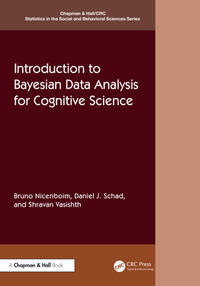
Stock photo: cover may vary

Introduction to Bayesian Data Analysis for Cognitive Science Paperback - 2025

by Bruno Nicenboim; Daniel J. Schad; Shravan Vasishth

Add to wish list
  • New
New

Description

New/New. Brand New Original US Edition, Perfect Condition. Printed in English. Excellent Quality, Service and customer satisfaction guaranteed!
Ask the seller a question Add to wish list
A$110.99
A$22.01 Delivery to USA
Standard delivery: 7 to 14 days
More delivery options
Ships from Students Textbooks (India)

Details

  • Title Introduction to Bayesian Data Analysis for Cognitive Science
  • Author Bruno Nicenboim; Daniel J. Schad; Shravan Vasishth
  • Binding Paperback
  • Condition New
  • Pages 608
  • Volumes 1
  • Language ENG
  • Publisher CRC Press
  • Publication date 2025-08-20
  • Illustrated Yes
  • Features Illustrated
  • Bookseller's Inventory # BIBNNA-9087
  • ISBN 9780367359331 / 0367359332
  • Weight 2.39 lbs (1.08 kg)
  • Dimensions 10 x 7 x 1.28 in (25.40 x 17.78 x 3.25 cm)
  • Category Psychology
  • Quantity available 1

About Students Textbooks India

Biblio member since 2009

Selling textbooks, International editions and reference books online from last 5 Years.

Terms of Sale:

30 day return guarantee, with full refund including shipping costs for up to 30 days after delivery if an item arrives misdescribed or damaged. Return address: Students_Textbooks 12 phankha road Jankpuri New Delhi 110036 India

Browse books from Students Textbooks

Reader reviews for Introduction to Bayesian Data Analysis for Cognitive Science

From the publisher

This book introduces Bayesian data analysis and Bayesian cognitive modeling to students and researchers in cognitive science (e.g., linguistics, psycholinguistics, psychology, computer science), with a particular focus on modeling data from planned experiments. The book relies on the probabilistic programming language Stan and the R package brms, which is a front-end to Stan. The book only assumes that the reader is familiar with the statistical programming language R, and has basic high school exposure to pre-calculus mathematics; some of the important mathematical constructs needed for the book are introduced in the first chapter.

Through this book, the reader will be able to develop a practical ability to apply Bayesian modeling within their own field. The book begins with an informal introduction to foundational topics such as probability theory, and univariate and bi-/multivariate discrete and continuous random variables. Then, the application of Bayes' rule for statistical inference is introduced with several simple analytical examples that require no computing software; the main insight here is that the posterior distribution of a parameter is a compromise between the prior and the likelihood functions. The book then gradually builds up the regression framework using the brms package in R, ultimately leading to hierarchical regression modeling (aka the linear mixed model). Along the way, there is detailed discussion about the topic of prior selection, and developing a well-defined workflow. Later chapters introduce the Stan programming language, and cover advanced topics using practical examples: contrast coding, model comparison using Bayes factors and cross-validation, hierarchical models and reparameterization, defining custom distributions, measurement error models and meta-analysis, and finally, some examples of cognitive models: multinomial processing trees, finite mixture models, and accumulator models. Additional chapters, appendices, and exercises are provided as online materials and can be accessed here: https: //github.com/bnicenboim/bayescogsci. Further additional material can be accessed here: https: //open.hpi.de/courses/bayesian-statistics2023 and here: https: //vasishth.github.io/LecturesIntroBayes/.

About the author

Bruno Nicenboim is assistant professor in the department of Cognitive Science and Artificial Intelligence at Tilburg University in the Netherlands, working within the area of computational psycholinguistics.

Daniel J. Schad is a cognitive psychologist and is professor of Quantitative Methods at the HMU Health
and Medical University in Potsdam, Germany.

Shravan Vasishth is professor of psycholinguistics at the department of Linguistics at the University of Potsdam, Germany; he is a chartered statistician (Royal Statistical Society, UK).

tracking-