
Stock photo: cover may vary
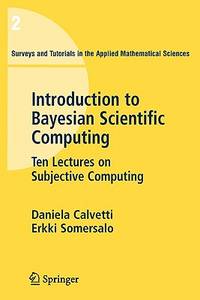
Introduction to Bayesian Scientific Computing: Ten Lectures on Subjective Computing (Surveys and Tutorials in the Applied Mathematical Sciences) Paperback - 2007
by Daniela Calvetti
- Used
- Paperback
A$100.61
Free Delivery within USA
Standard delivery: 5 to 10 days
More delivery options
Standard delivery: 5 to 10 days
Dropship order
Ships from Ergodebooks (Texas, United States)
Details
- Title Introduction to Bayesian Scientific Computing: Ten Lectures on Subjective Computing (Surveys and Tutorials in the Applied Mathematical Sciences)
- Author Daniela Calvetti
- Binding Paperback
- Condition Used: Good
- Pages 202
- Volumes 1
- Language ENG
- Publisher Springer, New York
- Publication date 2007-11-26
- Illustrated Yes
- Features Bibliography, Illustrated, Index, Table of Contents
- Bookseller's Inventory # SONG0387733930
- ISBN 9780387733937 / 0387733930
- Weight 0.66 lbs (0.30 kg)
- Dimensions 9.1 x 6 x 0.5 in (23.11 x 15.24 x 1.27 cm)
- Size 6.10x0.50x9.25
- Category Mathematics
- Library of Congress subjects Bayesian statistical decision theory, Mathematical statistics
- Library of Congress Catalogue Number 2007936617
- Dewey Decimal Code 519.542
- Quantity available 1
About Ergodebooks Texas, United States
Biblio member since 2005
Our goal is to provide best customer service and good condition books for the lowest possible price. We are always honest about condition of book. We list book only by ISBN # and hence exact book is guaranteed.
We have 30 day return policy.
Reader reviews for Introduction to Bayesian Scientific Computing: Ten Lectures on Subjective Computing (Surveys and Tutorials in the Applied Mathematical Sciences)
Write a review for this book
Important Terms and Guidelines
- Please focus on the book’s content and context. Also, add any personal comments as to how you enjoyed the book. Substantiate your likes and dislikes. You may make comparisons to other books.
- Reviews must be at least 140 characters in length.
- Please do not reveal critical plot elements.
- This is not a help line. Contact customer support if you need help.
Your review must not include:
- Obscenities, discriminatory language, or other insulting language not suitable for public domain
- Advertisements, “spam” content, or references to other products, offers or websites.
- Email addresses, URLs, phone numbers, physical addresses or other contact information.
- Overly critical comments about other reviews or reviewers
- Time-sensitive material (i.e. promotional tours, seminars, lectures, etc.)
- Availability, price, or alternative ordering/shipping information
From the publisher
From the rear cover
A combination of the concepts subjective - or Bayesian - statistics and scientific computing, the book provides an integrated view across numerical linear algebra and computational statistics. Inverse problems act as the bridge between these two fields where the goal is to estimate an unknown parameter that is not directly observable by using measured data and a mathematical model linking the observed and the unknown.
Inverse problems are closely related to statistical inference problems, where the observations are used to infer on an underlying probability distribution. This connection between statistical inference and inverse problems is a central topic of the book. Inverse problems are typically ill-posed: small uncertainties in data may propagate in huge uncertainties in the estimates of the unknowns. To cope with such problems, efficient regularization techniques are developed in the framework of numerical analysis. The counterpart of regularization in the framework of statistical inference is the use prior information. This observation opens the door to a fruitful interplay between statistics and numerical analysis: the statistical framework provides a rich source of methods that can be used to improve the quality of solutions in numerical analysis, and vice versa, the efficient numerical methods bring computational efficiency to the statistical inference problems.
This book is intended as an easily accessible reader for those who need numerical and statistical methods in applied sciences.

