
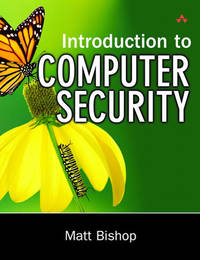
Stock photo: cover may vary
Introduction to Computer Security Hardback - 2004
by Bishop, Matt
- Used
- Hardback
- first
A$15.94
A$21.75
Delivery within USA
Standard delivery: 12 to 14 days
More delivery options
Standard delivery: 12 to 14 days
Dropship order
Ships from Ergodebooks (Texas, United States)
Details
- Title Introduction to Computer Security
- Author Bishop, Matt
- Binding Hardback
- Edition 1
- Condition Used: Good
- Pages 792
- Volumes 1
- Language ENG
- Publisher Addison-Wesley Professional, U.S.A
- Publication date 2004-10-26
- Abridged Yes
- Illustrated Yes
- Bookseller's Inventory # SONG0321247442
- ISBN 9780321247445 / 0321247442
- Weight 3.06 lbs (1.39 kg)
- Dimensions 74.01 x 1.18 x 55.12 in (187.99 x 3.00 x 140.00 cm)
- Size 7.64x1.18x9.41
- Category Computers - Communications / Networking
- Library of Congress subjects Computer security
- Library of Congress Catalogue Number 2004019195
- Dewey Decimal Code 005.8
- Quantity available 1
About Ergodebooks Texas, United States
Biblio member since 2005
Our goal is to provide best customer service and good condition books for the lowest possible price. We are always honest about condition of book. We list book only by ISBN # and hence exact book is guaranteed.
We have 30 day return policy.
Reader reviews for Introduction to Computer Security
Write a review for this book
Important Terms and Guidelines
- Please focus on the book’s content and context. Also, add any personal comments as to how you enjoyed the book. Substantiate your likes and dislikes. You may make comparisons to other books.
- Reviews must be at least 140 characters in length.
- Please do not reveal critical plot elements.
- This is not a help line. Contact customer support if you need help.
Your review must not include:
- Obscenities, discriminatory language, or other insulting language not suitable for public domain
- Advertisements, “spam” content, or references to other products, offers or websites.
- Email addresses, URLs, phone numbers, physical addresses or other contact information.
- Overly critical comments about other reviews or reviewers
- Time-sensitive material (i.e. promotional tours, seminars, lectures, etc.)
- Availability, price, or alternative ordering/shipping information
From the publisher
From the rear cover
In this authoritative book, widely respected practitioner and teacher Matt Bishop presents a clear and useful introduction to the art and science of information security. Bishop's insights and realistic examples will help any practitioner or student understand the crucial links between security theory and the day-to-day security challenges of IT environments.
Bishop explains the fundamentals of security: the different types of widely used policies, the mechanisms that implement these policies, the principles underlying both policies and mechanisms, and how attackers can subvert these tools--as well as how to defend against attackers. A practicum demonstrates how to apply these ideas and mechanisms to a realistic company.
Coverage includes
- Confidentiality, integrity, and availability
- Operational issues, cost-benefit and risk analyses, legal and human factors
- Planning and implementing effective access control
- Defining security, confidentiality, and integrity policies
- Using cryptography and public-key systems, and recognizing their limits
- Understanding and using authentication: from passwords to biometrics
- Security design principles: least-privilege, fail-safe defaults, open design, economy of mechanism, and more
- Controlling information flow through systems and networks
- Assuring security throughout the system lifecycle
- Malicious logic: Trojan horses, viruses, boot sector and executable infectors, rabbits, bacteria, logic bombs--and defenses against them
- Vulnerability analysis, penetration studies, auditing, and intrusion detection and prevention
- Applying security principles to networks, systems, users, and programs
Introduction to Computer Security is adapted from Bishop's comprehensive and widely praised book, Computer Security: Art and Science. This shorter version of the original work omits much mathematical formalism, making it more accessible for professionals and students who have a less formal mathematical background, or for readers with a more practical than theoretical interest.

