
Stock photo: cover may vary
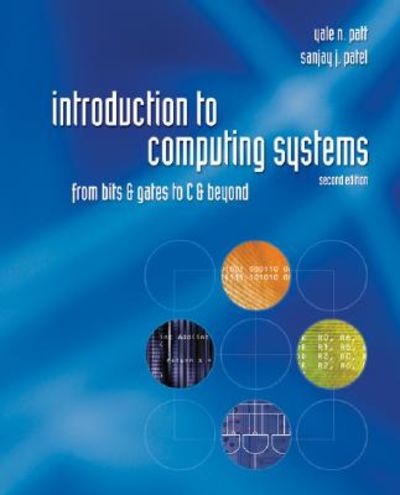
Introduction to Computing Systems: From bits & gates to C & beyond Hardback - 2003
by Yale N. Patt
- Used
- Hardback
A$22.28
Free Delivery within USA
Standard delivery: 5 to 10 days
More delivery options
Standard delivery: 5 to 10 days
Dropship order
Ships from Ergodebooks (Texas, United States)
Details
- Title Introduction to Computing Systems: From bits & gates to C & beyond
- Author Yale N. Patt
- Binding Hardback
- Edition 2nd
- Condition Used: Good
- Pages 656
- Volumes 1
- Language ENG
- Publisher McGraw-Hill Education, Blacklick, Ohio, U.s.a.
- Publication date 2003-08-05
- Illustrated Yes
- Bookseller's Inventory # SONG0072467509
- ISBN 9780072467505 / 0072467509
- Weight 2.58 lbs (1.17 kg)
- Dimensions 9.16 x 7.6 x 1.19 in (23.27 x 19.30 x 3.02 cm)
- Size 7.60x1.20x9.40
- Category Computers - General Information
- Library of Congress subjects Computer science, C (Computer program language)
- Library of Congress Catalogue Number 2003051002
- Dewey Decimal Code 004
- Quantity available 1
About Ergodebooks Texas, United States
Biblio member since 2005
Our goal is to provide best customer service and good condition books for the lowest possible price. We are always honest about condition of book. We list book only by ISBN # and hence exact book is guaranteed.
We have 30 day return policy.
Summary
Introduction to Computing Systems: From bits & gates to C & beyond, now in its second edition, is designed to give students a better understanding of computing early in their college careers in order to give them a stronger foundation for later courses. The book is in two parts: (a) the underlying structure of a computer, and (b) programming in a high level language and programming methodology.
To understand the computer, the authors introduce the LC-3 and provide the LC-3 Simulator to give students hands-on access for testing what they learn. To develop their understanding of programming and programming methodology, they use the C programming language. The book takes a “motivated” bottom-up approach, where the students first get exposed to the big picture and then start at the bottom and build their knowledge bottom-up. Within each smaller unit, the same motivated bottom-up approach is followed. Every step of the way, students learn new things, building on what they already know. The authors feel that this approach encourages deeper understanding and downplays the need for memorizing. Students develop a greater breadth of understanding, since they see how the various parts of the computer fit together.
Reader reviews for Introduction to Computing Systems: From bits & gates to C & beyond
Write a review for this book
Important Terms and Guidelines
- Please focus on the book’s content and context. Also, add any personal comments as to how you enjoyed the book. Substantiate your likes and dislikes. You may make comparisons to other books.
- Reviews must be at least 140 characters in length.
- Please do not reveal critical plot elements.
- This is not a help line. Contact customer support if you need help.
Your review must not include:
- Obscenities, discriminatory language, or other insulting language not suitable for public domain
- Advertisements, “spam” content, or references to other products, offers or websites.
- Email addresses, URLs, phone numbers, physical addresses or other contact information.
- Overly critical comments about other reviews or reviewers
- Time-sensitive material (i.e. promotional tours, seminars, lectures, etc.)
- Availability, price, or alternative ordering/shipping information
From the publisher
First line
HASH(0x17dfaa10)

