
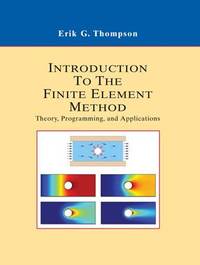
Stock photo: cover may vary
Introduction to the Finite Element Method: Theory, Programming and Applications Hardback - 2004
by Thompson, Erik G
- New
A$655.25
Free Delivery within USA
Standard delivery: 2 to 8 days
More delivery options
Standard delivery: 2 to 8 days
Ships from Jubilee Books (Michigan, United States)
Details
- Title Introduction to the Finite Element Method: Theory, Programming and Applications
- Author Thompson, Erik G
- Binding Hardback
- Edition INTERNATIONAL ED
- Condition New
- Pages 360
- Volumes 1
- Language ENG
- Publisher Wiley, Somerset, New Jersey, U.S.A.
- Publication date February 4, 2004
- Illustrated Yes
- Features Bibliography, Illustrated, Index
- Bookseller's Inventory # 0471267538
- ISBN 9780471267539 / 0471267538
- Weight 1.88 lbs (0.85 kg)
- Dimensions 9.78 x 8.26 x 0.78 in (24.84 x 20.98 x 1.98 cm)
- Category Technology & Industrial Arts
- Library of Congress subjects Finite element method
- Library of Congress Catalogue Number 2003063425
- Dewey Decimal Code 620.001
About Jubilee Books Michigan, United States
Biblio member since 2026
Welcome to Jublee Books! Here you will find an array of sought-after books, ranging from academic publications to popular novels. We strive to always expand our inventory so please feel free to check in from time to time!
30 day return guarantee, with full refund including original shipping costs for up to 30 days after delivery if an item arrives misdescribed or damaged.
Reader reviews for Introduction to the Finite Element Method: Theory, Programming and Applications
Write a review for this book
Important Terms and Guidelines
- Please focus on the book’s content and context. Also, add any personal comments as to how you enjoyed the book. Substantiate your likes and dislikes. You may make comparisons to other books.
- Reviews must be at least 140 characters in length.
- Please do not reveal critical plot elements.
- This is not a help line. Contact customer support if you need help.
Your review must not include:
- Obscenities, discriminatory language, or other insulting language not suitable for public domain
- Advertisements, “spam” content, or references to other products, offers or websites.
- Email addresses, URLs, phone numbers, physical addresses or other contact information.
- Overly critical comments about other reviews or reviewers
- Time-sensitive material (i.e. promotional tours, seminars, lectures, etc.)
- Availability, price, or alternative ordering/shipping information
From the publisher
First line
HASH(0x10abc1d0)
From the rear cover
The right balance of theory, programming, and applications
Erik Thompson presents the theory, applications, and programming skills you'll need to understand the finite element method and use it to solve problems in engineering analysis and design. Offering concise, highly practical coverage, this introductory text presents complete finite element codes that can be run on the student version of MATLAB or easily converted to other languages.
Master the basic theory: The text promotes an understanding and appreciation of the theoretical basis of finite element approximations by building on concepts that are intuitive. Throughout, the text uses matrix notation to help you visualize the finite element matrices. Study problems reinforce basic theory.
Experiment with the code: Numerical experiments show how to test programs for possible errors, experiment with boundary conditions, and study accuracy and stability. Code development exercises suggest ways to modify the codes to create additional capabilities. All codes are available on the book's web page along with sample data files for testing them. Each code can be immediately run using only the student version of MATLAB. Because each code is written using explicit programming, they also serve as pseudo-codes that can be used to develop programs in any computer language.
Gain hands-on experience: Projects, representing a wide variety of engineering disciplines, enable you to conduct analyses of fairly complex problems. Many of these projects encourage you to investigate new techniques for using the finite element method.

