BIBLIO is the largest independent book marketplace in the world, with over 100 million books.

Skip to content

Introduction to Mathematical Thinking

Introduction to Mathematical Thinking

Introduction to Mathematical Thinking
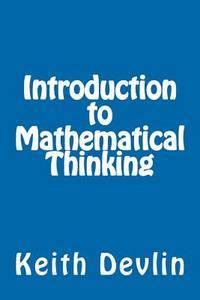
Stock photo: cover may vary

Introduction to Mathematical Thinking Paperback - 2012

by Devlin, Keith

Add to wish list
  • Used
Used - Very good

Description

Keith Devlin. Used - Very Good. Pages intact with possible writing/highlighting. Binding strong with minor wear. Dust jackets/supplements may not be included. Stock photo provided. Product includes identifying sticker. Better World Books: Buy Books. Do Good.
Ask the seller a question Add to wish list
A$11.76
Free Delivery within USA
Standard delivery: 4 to 8 days
More delivery options
Ships from Better World Books (Indiana, United States)

Details

  • Title Introduction to Mathematical Thinking
  • Author Devlin, Keith
  • Binding Paperback
  • Edition [ Edition: repri
  • Condition Used - Very good
  • Pages 104
  • Volumes 1
  • Language ENG
  • Publisher Keith Devlin
  • Publication date 2012-07-18
  • Features Index
  • Bookseller's Inventory # 4862489-6
  • ISBN 9780615653631 / 0615653634
  • Weight 0.35 lbs (0.16 kg)
  • Dimensions 8.8 x 5.9 x 0.4 in (22.35 x 14.99 x 1.02 cm)
  • Category Mathematics
  • Library of Congress subjects Mathematics - Philosophy
  • Dewey Decimal Code 510.1
  • Quantity available 5

About Better World Books Indiana, United States

Biblio member since 2005

Better World Books is a for-profit, socially conscious business and a global online bookseller that collects and sells new and used books online, matching each purchase with a book donation. Each sale generates funds for literacy and education initiatives in the U.S., the UK, and around the world. Since its launch in 2003, Better World Books has raised over $35 million for libraries and literacy, donated over 38 million books, and reused or recycled more than 475 million books.

Terms of Sale: Better World Books ("BWB") values your satisfaction and offers you returns within thirty (30) days after the estimated delivery date on most items. All returned items must be in the original condition; used items should include the SKU sticker located on the spine or back of the product. If you have an incomplete, incorrect, or damaged shipment, please contact our Customer Care team via Biblio's contact seller options before proceeding with the return. Please keep in mind that because we deal mostly in used books, any extra components, such as CDs, DVDs, figurines, or access codes are not included.

Browse books from Better World Books

Reader reviews for Introduction to Mathematical Thinking

From the publisher

In the twenty-first century, everyone can benefit from being able to think mathematically. This is not the same as "doing math." The latter usually involves the application of formulas, procedures, and symbolic manipulations; mathematical thinking is a powerful way of thinking about things in the world -- logically, analytically, quantitatively, and with precision. It is not a natural way of thinking, but it can be learned.Mathematicians, scientists, and engineers need to "do math," and it takes many years of college-level education to learn all that is required. Mathematical thinking is valuable to everyone, and can be mastered in about six weeks by anyone who has completed high school mathematics. Mathematical thinking does not have to be about mathematics at all, but parts of mathematics provide the ideal target domain to learn how to think that way, and that is the approach taken by this short but valuable book.The book is written primarily for first and second year students of science, technology, engineering, and mathematics (STEM) at colleges and universities, and for high school students intending to study a STEM subject at university. Many students encounter difficulty going from high school math to college-level mathematics. Even if they did well at math in school, most are knocked off course for a while by the shift in emphasis, from the K-12 focus on mastering procedures to the "mathematical thinking" characteristic of much university mathematics. Though the majority survive the transition, many do not. To help them make the shift, colleges and universities often have a "transition course." This book could serve as a textbook or a supplementary source for such a course.Because of the widespread applicability of mathematical thinking, however, the book has been kept short and written in an engaging style, to make it accessible to anyone who seeks to extend and improve their analytic thinking skills. Going beyond a basic grasp of analytic thinking that everyone can benefit from, the STEM student who truly masters mathematical thinking will find that college-level mathematics goes from being confusing, frustrating, and at times seemingly impossible, to making sense and being hard but doable.Dr. Keith Devlin is a professional mathematician at Stanford University and the author of 31 previous books and over 80 research papers. His books have earned him many awards, including the Pythagoras Prize, the Carl Sagan Award, and the Joint Policy Board for Mathematics Communications Award. He is known to millions of NPR listeners as "the Math Guy" on Weekend Edition with Scott Simon. He writes a popular monthly blog "Devlin's Angle" for the Mathematical Association of America, another blog under the name "profkeithdevlin", and also blogs on various topics for the Huffington Post.

About the author

Dr. Keith Devlin is a mathematician at Stanford University in California, where he is Executive Director of the university's H-STAR institute. He is a World Economic Forum Fellow and a Fellow of the American Association for the Advancement of Science. His current research is focused on the use of different media to teach and communicate mathematics to diverse audiences. He also works on the design of information/reasoning systems for intelligence analysis. Other research interests include: theory of information, models of reasoning, applications of mathematical techniques in the study of communication, and mathematical cognition. He has written 31 books and over 80 published research articles. His books have won a number of prizes, including the Pythagoras Prize, the Peano Prize, the Carl Sagan Award, and the Joint Policy Board for Mathematics Communications Award. In 2003, he was recognized by the California State Assembly for his "innovative work and longtime service in the field of mathematics and its relation to logic and linguistics." He is "the Math Guy" on National Public Radio.
tracking-