
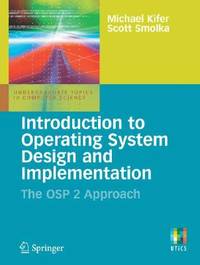
Stock photo: cover may vary
Introduction To Operating System Design and Implementation Paperback - 2007
by Michael Kifer, Scott a Smolka,
- New
A$84.00
A$5.86
Delivery within USA
Standard delivery: 2 to 14 days
More delivery options
Standard delivery: 2 to 14 days
Ships from GreatBookPrices (Maryland, United States)
Details
- Title Introduction To Operating System Design and Implementation
- Author Michael Kifer, Scott a Smolka,
- Binding Paperback
- Edition INTERNATIONAL ED
- Condition New
- Pages 172
- Volumes 1
- Language ENG
- Publisher Springer
- Publication date 2007-08-14
- Features Bibliography, Index, Table of Contents
- Bookseller's Inventory # 5150418-n
- ISBN 9781846288425 / 1846288428
- Weight 0.75 lbs (0.34 kg)
- Dimensions 9.2 x 6.9 x 0.5 in (23.37 x 17.53 x 1.27 cm)
- Category Computers - Operating Systems
- Library of Congress Catalogue Number 2007926598
- Dewey Decimal Code 005.43
- Quantity available 5
About GreatBookPrices Maryland, United States
Biblio member since 2024
Since 1991, we have worked every day to serve our customers with state-of-the-art technology and world class service. We are dedicated to providing customers around the world with the widest selection of books, DVDs, and CDs at the absolute lowest price.
Reader reviews for Introduction To Operating System Design and Implementation
Write a review for this book
Important Terms and Guidelines
- Please focus on the book’s content and context. Also, add any personal comments as to how you enjoyed the book. Substantiate your likes and dislikes. You may make comparisons to other books.
- Reviews must be at least 140 characters in length.
- Please do not reveal critical plot elements.
- This is not a help line. Contact customer support if you need help.
Your review must not include:
- Obscenities, discriminatory language, or other insulting language not suitable for public domain
- Advertisements, “spam” content, or references to other products, offers or websites.
- Email addresses, URLs, phone numbers, physical addresses or other contact information.
- Overly critical comments about other reviews or reviewers
- Time-sensitive material (i.e. promotional tours, seminars, lectures, etc.)
- Availability, price, or alternative ordering/shipping information
From the publisher
From the rear cover
Understanding the main principles and algorithms underlying a modern operating system is essential in undergraduate computer science. The complexity of this subject, however, means that mastering it requires significant practical experience. This unique book accomplishes just that: it teaches introductory subjects in OS design and implementation through hands-on engagement with OSP 2, the next generation of the highly popular OSP courseware.
This book exposes students to many essential features of operating systems while at the same time isolating them from low-level, machine-dependent concerns. With its accompanying software, the book contains enough projects for up to three semesters. Even one semester's study, however, suffices to cover page-replacement strategies in virtual memory management, CPU scheduling strategies, disk seek-time optimization and other issues in operating system design.
Features include:
- Provides an opportunity to practice OS design and implementation skills in a realistic, flexible, and easy-to-use systems programming environment that promotes "active learning" and reinforces lecture material.
- OSP 2 is written in Java, so that students learn an object-oriented approach to OS design and implementation.
- Contains many pedagogical tools: chapter goals, internet support for students and instructors; OSP 2 courseware and an instructors' manual, which includes helpful tips for course instructors and sample assignments, is available at www.springer.com/978-1-84628-842-5.
- Each chapter includes self-contained explanations of the OS concepts underlying the student project for that chapter.
Written for undergraduates in a first operating systems course, this text provides essential foundations through the user-friendly, highly flexible OSP 2 courseware environment.

