
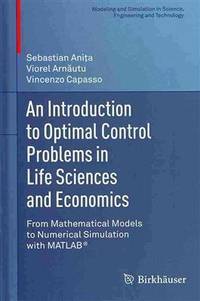
Stock photo: cover may vary
An Introduction to Optimal Control Problems in Life Sciences and Economics: From Mathematical Models to Numerical Simulation with MATLAB® (Modeling ... in Science, Engineering and Technology) Hardback - 2010 - 2011th Edition
by Ani?a, Sebastian
- Used
- Good
- Hardback
A$129.52
Free Delivery within USA
Standard delivery: 7 to 14 days
More delivery options
Standard delivery: 7 to 14 days
Dropship order
Ships from Bonita (California, United States)
Details
- Title An Introduction to Optimal Control Problems in Life Sciences and Economics: From Mathematical Models to Numerical Simulation with MATLAB® (Modeling ... in Science, Engineering and Technology)
- Author Ani?a, Sebastian
- Binding Hardback
- Edition number 2011th
- Edition 2011
- Condition Used - Good
- Pages 232
- Volumes 1
- Language ENG
- Publisher Birkhauser
- Publication date 2010-10-28
- Illustrated Yes
- Features Bibliography, Illustrated
- Bookseller's Inventory # 0817680977.G
- ISBN 9780817680978 / 0817680977
- Weight 1.16 lbs (0.53 kg)
- Dimensions 9.21 x 6.14 x 0.63 in (23.39 x 15.60 x 1.60 cm)
- Category Mathematics
- Library of Congress subjects Biology - Mathematical models, Control theory
- Library of Congress Catalogue Number 2010937643
- Dewey Decimal Code 570.15
- Quantity available 1
About Bonita California, United States
Reader reviews for An Introduction to Optimal Control Problems in Life Sciences and Economics: From Mathematical Models to Numerical Simulation with MATLAB® (Modeling ... in Science, Engineering and Technology)
Write a review for this book
Important Terms and Guidelines
- Please focus on the book’s content and context. Also, add any personal comments as to how you enjoyed the book. Substantiate your likes and dislikes. You may make comparisons to other books.
- Reviews must be at least 140 characters in length.
- Please do not reveal critical plot elements.
- This is not a help line. Contact customer support if you need help.
Your review must not include:
- Obscenities, discriminatory language, or other insulting language not suitable for public domain
- Advertisements, “spam” content, or references to other products, offers or websites.
- Email addresses, URLs, phone numbers, physical addresses or other contact information.
- Overly critical comments about other reviews or reviewers
- Time-sensitive material (i.e. promotional tours, seminars, lectures, etc.)
- Availability, price, or alternative ordering/shipping information
From the publisher
From the rear cover
Combining two important and growing areas of applied mathematics--control theory and modeling--this textbook introduces and builds on methods for simulating and tackling problems in a variety of applied sciences. Control theory has moved from primarily being used in engineering to an important theoretical component for optimal strategies in other sciences, such as therapies in medicine or policy in economics. Applied to mathematical models, control theory has the power to change the way we view biological and financial systems, taking us a step closer to solving concrete problems that arise out of these systems.
Emphasizing "learning by doing," the authors focus on examples and applications to real-world problems, stressing concepts and minimizing technicalities. An elementary presentation of advanced concepts from the mathematical theory of optimal control is provided, giving readers the tools to solve significant and realistic problems. Proofs are also given whenever they may serve as a guide to the introduction of new concepts. This approach not only fosters an understanding of how control theory can open up modeling in areas such as the life sciences, medicine, and economics, but also guides readers from applications to new, independent research.
Key features include:
* An introduction to the main tools of MATLAB(R), as well as programs that move from relatively simple ODE applications to more complex PDE models;
* Numerous applications to a wide range of subjects, including HIV and insulin treatments, population dynamics, and stock management;
* Exploration of cutting-edge topics in later chapters, such as optimal harvesting and optimal control of diffusive models, designed to stimulate further research and theses projects;
* Exercises in each chapter, allowing students a chance to work with MATLAB and achieve a better grasp of the applications;
* Minimal prerequisites: undergraduate-level calculus;
*Appendices with basic concepts and results from functional analysis and ordinary differential equations, including Runge-Kutta methods;
* Supplementary MATLAB files are available at the publisher's website: http: //www.birkhauser-science.com/978-0-8176-8097-8/.
As a guided tour to methods in optimal control and related computational methods for ODE and PDE models, An Introduction to Optimal Control Problems in Life Sciences and Economics serves as an excellent textbook for graduate and advanced undergraduate courses in mathematics, physics, engineering, computer science, biology, biotechnology, and economics. The work is also a useful reference for researchers and practitioners working with optimal control theory in these areas.

