
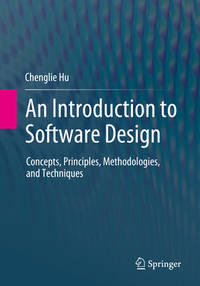
Stock photo: cover may vary
An Introduction to Software Design Paperback - 2023
by Chenglie Hu
- New
A$98.49
A$21.78
Delivery to USA
Standard delivery: 7 to 14 days
More delivery options
Standard delivery: 7 to 14 days
Details
- Title An Introduction to Software Design
- Author Chenglie Hu
- Binding Paperback
- Condition New
- Pages 359
- Volumes 1
- Language ENG
- Publisher Springer
- Publication date 2023-07-25
- Illustrated Yes
- Features Illustrated
- Bookseller's Inventory # BIBNNA-25344
- ISBN 9783031283109 / 3031283104
- Weight 1.32 lbs (0.60 kg)
- Dimensions 9.61 x 6.69 x 0.78 in (24.41 x 16.99 x 1.98 cm)
- Category Computers - Languages / Programming
- Quantity available 2
About Students Textbooks India
Specialising in: International Edition., Textbooks
Biblio member since 2009
Selling textbooks, International editions and reference books online from last 5 Years.
30 day return guarantee, with full refund including shipping costs for up to 30 days after delivery if an item arrives misdescribed or damaged. Return address: Students_Textbooks 12 phankha road Jankpuri New Delhi 110036 India
Reader reviews for An Introduction to Software Design
Write a review for this book
Important Terms and Guidelines
- Please focus on the book’s content and context. Also, add any personal comments as to how you enjoyed the book. Substantiate your likes and dislikes. You may make comparisons to other books.
- Reviews must be at least 140 characters in length.
- Please do not reveal critical plot elements.
- This is not a help line. Contact customer support if you need help.
Your review must not include:
- Obscenities, discriminatory language, or other insulting language not suitable for public domain
- Advertisements, “spam” content, or references to other products, offers or websites.
- Email addresses, URLs, phone numbers, physical addresses or other contact information.
- Overly critical comments about other reviews or reviewers
- Time-sensitive material (i.e. promotional tours, seminars, lectures, etc.)
- Availability, price, or alternative ordering/shipping information
From the publisher
From the rear cover
This textbook provides a balanced coverage on software design, including design principles, methodologies, and techniques in contexts of designing modules of small and larger sizes with a multi-paradigm viewpoint emphasizing design trade-off. Commonly used design diagrams and patterns are also covered in terms of the design ideas behind and their effective use. The book also explores what (software) design thinking is, the role it plays in a design process, and ways to promote it. Despite object orientation being still the center of attention, there is a strong promotion throughout the book that software design should consider all appropriate design paradigms and methodologies.
The book is organized in 10 chapters. Chapter 1 is dedicated to an exploration of what software design may be and entail. Next, chapters 2 and 3 are designed to help readers better understand object orientation, and the essentials of object-oriented design. Chapter 4 is then dedicated to the design of methods, while chapters 5, 6, and 8 respectively include topics about the design of objects, modeling with the Unified Modeling Language, and the use of design patterns. Larger software elements are often directly responsible for the formation of software architecture, thus chapter 7 covers four kinds of larger software elements: libraries, components, frameworks, and microservices, and their architectural implications. Chapter 9 finally brings the presentation of software design to an end with a coverage on software architecture focusing on software architectural views. Case studies are important in learning how to design software, hence chapter 10 then gathers some small design case studies that can be used in earlier chapters as appropriate. These case studies can be extended in different ways to provide additional design opportunities.
This textbook book is intended for a junior level undergraduate course on software design, yet the depth of the book makes it also appropriate for a design course at beginning graduate level. Professionals may also find the book useful in their professional development.
The book is organized in 10 chapters. Chapter 1 is dedicated to an exploration of what software design may be and entail. Next, chapters 2 and 3 are designed to help readers better understand object orientation, and the essentials of object-oriented design. Chapter 4 is then dedicated to the design of methods, while chapters 5, 6, and 8 respectively include topics about the design of objects, modeling with the Unified Modeling Language, and the use of design patterns. Larger software elements are often directly responsible for the formation of software architecture, thus chapter 7 covers four kinds of larger software elements: libraries, components, frameworks, and microservices, and their architectural implications. Chapter 9 finally brings the presentation of software design to an end with a coverage on software architecture focusing on software architectural views. Case studies are important in learning how to design software, hence chapter 10 then gathers some small design case studies that can be used in earlier chapters as appropriate. These case studies can be extended in different ways to provide additional design opportunities.
This textbook book is intended for a junior level undergraduate course on software design, yet the depth of the book makes it also appropriate for a design course at beginning graduate level. Professionals may also find the book useful in their professional development.

