
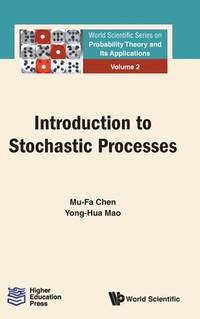
Stock photo: cover may vary
INTRODUCTION TO STOCHASTIC PROCESSES Hardback - 2021
by Mu-Fa Chen; Yong-Hua Mao
- New
A$120.19
A$21.52
Delivery to USA
Standard delivery: 7 to 14 days
More delivery options
Standard delivery: 7 to 14 days
Details
- Title INTRODUCTION TO STOCHASTIC PROCESSES
- Author Mu-Fa Chen; Yong-Hua Mao
- Binding Hardback
- Condition New
- Pages 244
- Volumes 1
- Language ENG
- Publisher World Scientific Publishing Company
- Publication date 2021-06-06
- Bookseller's Inventory # BIBNNA-197414
- ISBN 9789814740302 / 9814740306
- Weight 1.1 lbs (0.50 kg)
- Dimensions 9 x 6 x 0.63 in (22.86 x 15.24 x 1.60 cm)
- Category Mathematics
- Quantity available 1
About Students Textbooks India
Specialising in: International Edition., Textbooks
Biblio member since 2009
Selling textbooks, International editions and reference books online from last 5 Years.
30 day return guarantee, with full refund including shipping costs for up to 30 days after delivery if an item arrives misdescribed or damaged. Return address: Students_Textbooks 12 phankha road Jankpuri New Delhi 110036 India
Reader reviews for INTRODUCTION TO STOCHASTIC PROCESSES
Write a review for this book
Important Terms and Guidelines
- Please focus on the book’s content and context. Also, add any personal comments as to how you enjoyed the book. Substantiate your likes and dislikes. You may make comparisons to other books.
- Reviews must be at least 140 characters in length.
- Please do not reveal critical plot elements.
- This is not a help line. Contact customer support if you need help.
Your review must not include:
- Obscenities, discriminatory language, or other insulting language not suitable for public domain
- Advertisements, “spam” content, or references to other products, offers or websites.
- Email addresses, URLs, phone numbers, physical addresses or other contact information.
- Overly critical comments about other reviews or reviewers
- Time-sensitive material (i.e. promotional tours, seminars, lectures, etc.)
- Availability, price, or alternative ordering/shipping information
From the publisher
From the jacket flap
The objective here is to introduce the elements of stochastic processes in a rather concise manner where we present the two most important parts in stochastic processes Markov chains and stochastic analysis. The readers are lead directly to the core of the topics, and further details are collated in a section containing abundant exercises and more materials for further reading and studying.
In the part on Markov chains, the core is the ergodicity. By using the minimal non-negative solution method, we deal with the recurrence and various ergodicity. This is done step by step, from finite state spaces to denumerable state spaces, and from discrete time to continuous time. The proof methods adopt the modern techniques, such as coupling and duality methods. Some very new results are included, such as the estimate of the spectral gap. The structure and proofs in the first part are rather different from other existing textbooks on Markov chains.
In the part on stochastic analysis, we cover the martingale theory and Brownian motions, the stochastic integral and stochastic differential equations with emphasis on one dimension, and the multidimensional stochastic integral and stochastic equation based on semimartingales. We introduce three important topics here: the FeynmanKac formula, random time transform and Girsanov transform. As an essential application of the probability theory in classical mathematics, we also deal with the famous BrunnMinkowski inequality in convex geometry.
This volume also features modern probability theory that is used in the non-random fields, such as MCMC, convex geometry and number theory. It provides a new and direct routine for students going through the classical Markov chains to the modern stochastic analysis. It employs more modern techniques, such as coupling and duality, and functional inequalities with Dirichlet form.

