BIBLIO is the largest independent book marketplace in the world, with over 100 million books.

Skip to content

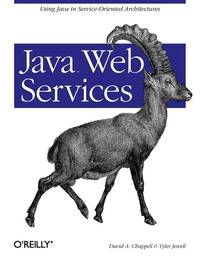
Java Web Services: Using Java in Service-Oriented Architectures

Java Web Services: Using Java in Service-Oriented Architectures

Java Web Services: Using Java in Service-Oriented Architectures
Stock photo: cover may vary

Java Web Services: Using Java in Service-Oriented Architectures Paperback - 2002 - 1st Edition

by Chappell, David A

Add to wish list
  • Used
Used - Good

Description

O'Reilly Media. Used - Good. Ships from UK in 48 hours or less (usually same day). Your purchase helps support Sri Lankan Children's Charity 'The Rainbow Centre'. Ex-library, so some stamps and wear, but in good overall condition. 100% money back guarantee. We are a world class secondhand bookstore based in Hertfordshire, United Kingdom and specialize in high quality textbooks across an enormous variety of subjects. We aim to provide a vast range of textbooks, rare and collectible books at a great price. Our donations to The Rainbow Centre have helped provide an education and a safe haven to hundreds of children who live in appalling conditions. We provide a 100% money back guarantee and are dedicated to providing our customers with the highest standards of service in the bookselling industry.
Ask the seller a question Add to wish list
A$6.35
A$17.49 Delivery to USA
Standard delivery: 14 to 21 days
More delivery options
Ships from Phatpocket Limited (Essex, United Kingdom)

Details

  • Title Java Web Services: Using Java in Service-Oriented Architectures
  • Author Chappell, David A
  • Binding Paperback
  • Edition number 1st
  • Edition 1
  • Condition Used - Good
  • Pages 276
  • Volumes 1
  • Language ENG
  • Publisher O'Reilly Media
  • Publication date 2002-04-23
  • Illustrated Yes
  • Features Illustrated, Index, Table of Contents
  • Bookseller's Inventory # Z1-I-021-01627
  • ISBN 9780596002695 / 0596002696
  • Weight 0.98 lbs (0.44 kg)
  • Dimensions 9.22 x 7.1 x 0.68 in (23.42 x 18.03 x 1.73 cm)
  • Category Computer - Internet
  • Library of Congress subjects Internet programming, Java (Computer program language)
  • Dewey Decimal Code 005.72

About Phatpocket Limited Essex, United Kingdom

Biblio member since 2006

Phatpocket Limited is a world class secondhand bookstore located in the Hertfordshire countryside in the United Kingdom. We specialize in textbooks across an enormous variety of subjects. We aim to provide a low cost source of high quality textbooks to the academic community. We also have a sizable collection of rare and collectible books.

We are dedicated to providing our customers with the highest standard of customer service in the bookselling business.

Terms of Sale:

Books are usually shipped in 48 hours or less. All of our books have a 14 day no hassle money back guarantee unless stated otherwise in the book's description. Item must be returned in the exact same condition that it was received. Through our work with The Rainbow Centre and other Charity Partners, we have already given hundreds of young people in Sri Lanka and Africa the vital chance to get an education.

Browse books from Phatpocket Limited

Reader reviews for Java Web Services: Using Java in Service-Oriented Architectures

From the publisher

For many Java developers, web services appeared to come out of nowhere. Its advantages are clear: web services are platform-independent (like Java itself), language-agnostic (a clear advantage over Java RMI), can easily be tunneled through firewalls (an obvious benefit to anyone who has dealt with modern enterprise networks), object-oriented (we all know about that), and tends to be loosely coupled (allowing more flexible application development). But these advantages have been obscured by a cloud of hype and a proliferation of jargon that are difficult to penetrate. What are SOAP, UDDI, WSDL, and JAXM? To say nothing of JAXR, tModels, category bags, WSFL, and other friends? And assuming that you understand what they are, how do you do anything with them? Do they live up to their promises? Are they really the future of network computing, or a dead end? Java Web Services gives the experienced Java developer a way into the Web Services world. It helps you to understand what's going on, what the technologies mean and how they relate, and shows Java developers how to put them to use to solve real problems. You'll learn what's real and what isn't; what the technologies are really supposed to do, and how they do it. Java Web Services shows you how to use SOAP to perform remote method calls and message passing; how to use WSDL to describe the interface to a web service or understand the interface of someone else's service; and how to use UDDI to advertise (publish) and look up services in each local or global registry. Java Web Services also discusses security issues, interoperability issues, integration with other Java enterprise technologies like EJB; the work being done on the JAXM and JAX-RPC packages, and integration with Microsoft's .NET services. The web services picture is still taking shape; there are many platforms and APIs to consider, and many conflicting claims from different marketing groups. And although web services are inherently language-independent, the fit between the fundamental principles on which Java and web services are based means that Java will almost certainly be the predominant language for web services development. If you're a Java developer and want to climb on the web services bandwagon, or if you only want to "kick the tires" and find out what web services has to offer, you will find this book indispensable.

About the author

Tyler Jewell, Director, Technical Evangelism, BEA Systems Tyler oversees BEA's technology evangelism efforts that are focused on driving early adoption of strategic BEA technologies into the ISV and developer community. He is the key figure for creating the joint technical alignment with many partners. He is also a technologist with expertise in Web Services, large-scale system design, and application infrastructures. Tyler is author of Java Web Services (O'Reilly, 2002), Mastering Enterprise JavaBeans 2.0 (Wiley, 2001) and Professional Java Server Programming J2EE 1.3 (Wrox, 2001). Tyler is a member of O'Reilly's Editorial Masthead and maintains a monthly J2EE column at www.onjava.com. He is also on the editorial boards of Sys-Con's WebLogic Developer's Journal and Web Services Journal and is the technology advisor to www.theserverside.com

tracking-