
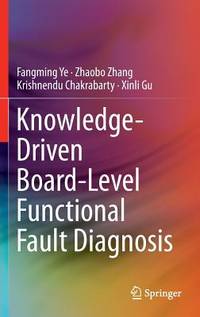
Stock photo: cover may vary
Knowledge-Driven Board-Level Functional Fault Diagnosis Hardback - 2016
by Ye, Fangming
- Used
- Good
- Hardback
A$181.52
Free Delivery within USA
Standard delivery: 7 to 14 days
More delivery options
Standard delivery: 7 to 14 days
Dropship order
Ships from Bonita (California, United States)
Details
- Title Knowledge-Driven Board-Level Functional Fault Diagnosis
- Author Ye, Fangming
- Binding Hardback
- Condition Used - Good
- Pages 147
- Volumes 1
- Language ENG
- Publisher Springer
- Publication date 2016-08-29
- Illustrated Yes
- Features Illustrated
- Bookseller's Inventory # 3319402099.G
- ISBN 9783319402093 / 3319402099
- Weight 0.9 lbs (0.41 kg)
- Dimensions 9.21 x 6.14 x 0.44 in (23.39 x 15.60 x 1.12 cm)
- Category Technology & Industrial Arts
- Dewey Decimal Code 006.312
- Quantity available 1
About Bonita California, United States
Reader reviews for Knowledge-Driven Board-Level Functional Fault Diagnosis
Write a review for this book
Important Terms and Guidelines
- Please focus on the book’s content and context. Also, add any personal comments as to how you enjoyed the book. Substantiate your likes and dislikes. You may make comparisons to other books.
- Reviews must be at least 140 characters in length.
- Please do not reveal critical plot elements.
- This is not a help line. Contact customer support if you need help.
Your review must not include:
- Obscenities, discriminatory language, or other insulting language not suitable for public domain
- Advertisements, “spam” content, or references to other products, offers or websites.
- Email addresses, URLs, phone numbers, physical addresses or other contact information.
- Overly critical comments about other reviews or reviewers
- Time-sensitive material (i.e. promotional tours, seminars, lectures, etc.)
- Availability, price, or alternative ordering/shipping information
From the publisher
From the rear cover
This book provides a comprehensive set of characterization, prediction, optimization, evaluation, and evolution techniques for a diagnosis system for fault isolation in large electronic systems. Readers with a background in electronics design or system engineering can use this book as a reference to derive insightful knowledge from data analysis and use this knowledge as guidance for designing reasoning-based diagnosis systems. Moreover, readers with a background in statistics or data analytics can use this book as a practical case study for adapting data mining and machine learning techniques to electronic system design and diagnosis. This book identifies the key challenges in reasoning-based, board-level diagnosis system design and presents the solutions and corresponding results that have emerged from leading-edge research in this domain. It covers topics ranging from highly accurate fault isolation, adaptive fault isolation, diagnosis-system robustness assessment, to system performance analysis and evaluation, knowledge discovery and knowledge transfer. With its emphasis on the above topics, the book provides an in-depth and broad view of reasoning-based fault diagnosis system design.
- Explains and applies optimized techniques from the machine-learning domain to solve the fault diagnosis problem in the realm of electronic system design and manufacturing;- Demonstrates techniques based on industrial data and feedback from an actual manufacturing line;- Discusses practical problems, including diagnosis accuracy, diagnosis time cost, evaluation of diagnosis system, handling of missing syndromes in diagnosis, and need for fast diagnosis-system development.
- Explains and applies optimized techniques from the machine-learning domain to solve the fault diagnosis problem in the realm of electronic system design and manufacturing;- Demonstrates techniques based on industrial data and feedback from an actual manufacturing line;- Discusses practical problems, including diagnosis accuracy, diagnosis time cost, evaluation of diagnosis system, handling of missing syndromes in diagnosis, and need for fast diagnosis-system development.

