
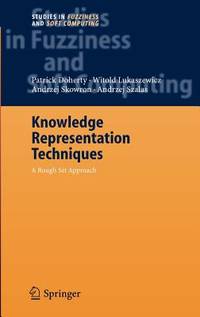
Stock photo: cover may vary
Knowledge Representation Techniques: A Rough Set Approach (Studies in Fuzziness and Soft Computing) Hardback - 2006
by Patrick Doherty; Witold Lukaszewicz; Andrzej Skowron; Andrzej Szalas
- New
- Hardback
A$447.71
A$8.53
Delivery within USA
Standard delivery: 2 to 21 days
More delivery options
Standard delivery: 2 to 21 days
Ships from GridFreed LLC (California, United States)
Details
- Title Knowledge Representation Techniques: A Rough Set Approach (Studies in Fuzziness and Soft Computing)
- Author Patrick Doherty; Witold Lukaszewicz; Andrzej Skowron; Andrzej Szalas
- Binding Hardback
- Edition 1st
- Condition New
- Pages 334
- Volumes 1
- Language ENG
- Publisher Springer
- Publication date 2006-07-17
- Bookseller's Inventory # Q-3540335188
- ISBN 9783540335184 / 3540335188
- Weight 1.47 lbs (0.67 kg)
- Dimensions 9.21 x 6.14 x 0.81 in (23.39 x 15.60 x 2.06 cm)
- Category Mathematics
- Dewey Decimal Code 006.332
- Quantity available 1
About GridFreed LLC California, United States
Biblio member since 2021
We sell primarily non-fiction, many new books, some collectible first editions and signed books. We operate 100% online and have been in business since 2005.
Reader reviews for Knowledge Representation Techniques: A Rough Set Approach (Studies in Fuzziness and Soft Computing)
Write a review for this book
Important Terms and Guidelines
- Please focus on the book’s content and context. Also, add any personal comments as to how you enjoyed the book. Substantiate your likes and dislikes. You may make comparisons to other books.
- Reviews must be at least 140 characters in length.
- Please do not reveal critical plot elements.
- This is not a help line. Contact customer support if you need help.
Your review must not include:
- Obscenities, discriminatory language, or other insulting language not suitable for public domain
- Advertisements, “spam” content, or references to other products, offers or websites.
- Email addresses, URLs, phone numbers, physical addresses or other contact information.
- Overly critical comments about other reviews or reviewers
- Time-sensitive material (i.e. promotional tours, seminars, lectures, etc.)
- Availability, price, or alternative ordering/shipping information
From the publisher
From the rear cover
The basis for the material in this book centers around a long term research project with autonomous unmanned aerial vehicle systems. One of the main research topics in the project is knowledge representation and reasoning. The focus of the research has been on the development of tractable combinations of approximate and nonmonotonic reasoning systems. The techniques developed are based on intuitions from rough set theory. Efforts have been made to take theory into practice by instantiating research results in the context of traditional relational database or deductive database systems. This book contains a cohesive, self-contained collection of many of the theoretical and applied research results that have been achieved in this project and for the most part pertain to nonmonotonic and approximate reasoning systems developed for an experimental unmanned aerial vehicle system used in the project. This book should be of interest to the theoretician and applied researcher alike and to autonomous system developers and software agent and intelligent system developers.

