
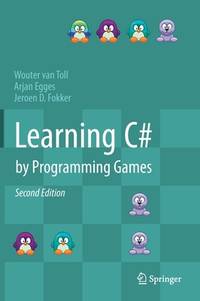
Stock photo: cover may vary
Learning C# by Programming Games Hardback - 2019
by van Toll, Wouter
- Used
- Hardback
A$76.09
Free Delivery within USA
Standard delivery: 5 to 10 days
More delivery options
Standard delivery: 5 to 10 days
Dropship order
Ships from Ergodebooks (Texas, United States)
Details
- Title Learning C# by Programming Games
- Author van Toll, Wouter
- Binding Hardback
- Edition 2nd ed. 2019
- Condition Used: Good
- Pages 512
- Volumes 1
- Language ENG
- Publisher Springer
- Publication date 2019-12-04
- Illustrated Yes
- Features Illustrated
- Bookseller's Inventory # SONG3662592517
- ISBN 9783662592519 / 3662592517
- Weight 2.53 lbs (1.15 kg)
- Dimensions 10 x 7 x 1.19 in (25.40 x 17.78 x 3.02 cm)
- Size 7.00x1.25x10.00
- Category Computers - General Information
- Dewey Decimal Code 004.16
- Quantity available 1
About Ergodebooks Texas, United States
Biblio member since 2005
Our goal is to provide best customer service and good condition books for the lowest possible price. We are always honest about condition of book. We list book only by ISBN # and hence exact book is guaranteed.
We have 30 day return policy.
Reader reviews for Learning C# by Programming Games
Write a review for this book
Important Terms and Guidelines
- Please focus on the book’s content and context. Also, add any personal comments as to how you enjoyed the book. Substantiate your likes and dislikes. You may make comparisons to other books.
- Reviews must be at least 140 characters in length.
- Please do not reveal critical plot elements.
- This is not a help line. Contact customer support if you need help.
Your review must not include:
- Obscenities, discriminatory language, or other insulting language not suitable for public domain
- Advertisements, “spam” content, or references to other products, offers or websites.
- Email addresses, URLs, phone numbers, physical addresses or other contact information.
- Overly critical comments about other reviews or reviewers
- Time-sensitive material (i.e. promotional tours, seminars, lectures, etc.)
- Availability, price, or alternative ordering/shipping information
From the rear cover
Developing computer games is a perfect way to learn how to program in modern programming languages. This book teaches how to program in C# through the creation of computer games - and without requiring any previous programming experience.
Contrary to most programming books, van Toll, Egges, and Fokker do not organize the presentation according to programming language constructs, but instead use the structure and elements of computer games as a framework. For instance, there are chapters on dealing with player input, game objects, game worlds, game states, levels, animation, physics, and intelligence. The reader will be guided through the development of four games showing the various aspects of game development. Starting with a simple shooting game, the authors move on to puzzle games consisting of multiple levels, and conclude the book by developing a full-fledged platform game with animation, game physics, and intelligent enemies. They show a number of commonly used techniques in games, such as drawing layers of sprites, rotating, scaling and animating sprites, dealing with physics, handling interaction between game objects, and creating pleasing visual effects. At the same time, they provide a thorough introduction to C# and object-oriented programming, introducing step by step important programming concepts such as loops, methods, classes, collections, and exception handling.
This second edition includes a few notable updates. First of all, the book and all example programs are now based on the library MonoGame 3.6, instead of the obsolete XNA Game Studio. Second, instead of explaining how the example programs work, the text now invites readers to write these programs themselves, with clearly marked reference points throughout the text. Third, the book now makes a clearer distinction between general (C#) programming concepts and concepts that are specific to game development. Fourth, the most important programming concepts are now summarized in convenient "Quick Reference" boxes, which replace the syntax diagrams of the first edition. Finally, the updated exercises are now grouped per chapter and can be found at the end of each chapter, allowing readers to test their knowledge more directly.
The book is also designed to be used as a basis for a game-oriented programming course. Supplementary materials for organizing such a course are available on an accompanying web site, which also includes all example programs, game sprites, sounds, and the solutions to all exercises.
Contrary to most programming books, van Toll, Egges, and Fokker do not organize the presentation according to programming language constructs, but instead use the structure and elements of computer games as a framework. For instance, there are chapters on dealing with player input, game objects, game worlds, game states, levels, animation, physics, and intelligence. The reader will be guided through the development of four games showing the various aspects of game development. Starting with a simple shooting game, the authors move on to puzzle games consisting of multiple levels, and conclude the book by developing a full-fledged platform game with animation, game physics, and intelligent enemies. They show a number of commonly used techniques in games, such as drawing layers of sprites, rotating, scaling and animating sprites, dealing with physics, handling interaction between game objects, and creating pleasing visual effects. At the same time, they provide a thorough introduction to C# and object-oriented programming, introducing step by step important programming concepts such as loops, methods, classes, collections, and exception handling.
This second edition includes a few notable updates. First of all, the book and all example programs are now based on the library MonoGame 3.6, instead of the obsolete XNA Game Studio. Second, instead of explaining how the example programs work, the text now invites readers to write these programs themselves, with clearly marked reference points throughout the text. Third, the book now makes a clearer distinction between general (C#) programming concepts and concepts that are specific to game development. Fourth, the most important programming concepts are now summarized in convenient "Quick Reference" boxes, which replace the syntax diagrams of the first edition. Finally, the updated exercises are now grouped per chapter and can be found at the end of each chapter, allowing readers to test their knowledge more directly.
The book is also designed to be used as a basis for a game-oriented programming course. Supplementary materials for organizing such a course are available on an accompanying web site, which also includes all example programs, game sprites, sounds, and the solutions to all exercises.

