BIBLIO is the largest independent book marketplace in the world, with over 100 million books.

Skip to content

Learning OpenCV 3: Computer Vision in C++ with the OpenCV Library

Learning OpenCV 3: Computer Vision in C++ with the OpenCV Library

Learning OpenCV 3: Computer Vision in C++ with the OpenCV Library
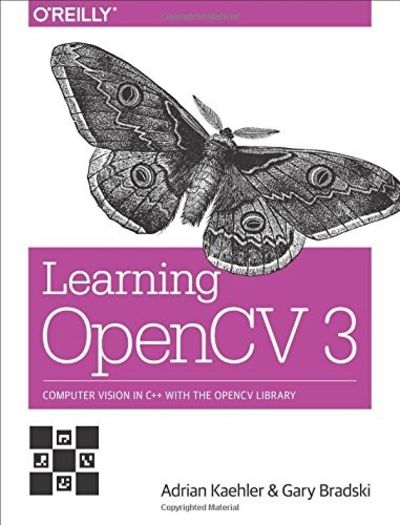
Stock photo: cover may vary

Learning OpenCV 3: Computer Vision in C++ with the OpenCV Library Paperback - 2017

by Kaehler, Adrian

Add to wish list
  • Used
Used - Good

Description

O'Reilly Media. Used - Good. Ships from UK in 48 hours or less (usually same day). Your purchase helps support Sri Lankan Children's Charity 'The Rainbow Centre'. Ex-library, so some stamps and wear, but in good overall condition. 100% money back guarantee. We are a world class secondhand bookstore based in Hertfordshire, United Kingdom and specialize in high quality textbooks across an enormous variety of subjects. We aim to provide a vast range of textbooks, rare and collectible books at a great price. Our donations to The Rainbow Centre have helped provide an education and a safe haven to hundreds of children who live in appalling conditions. We provide a 100% money back guarantee and are dedicated to providing our customers with the highest standards of service in the bookselling industry.
Ask the seller a question Add to wish list
A$15.79
A$17.45 Delivery to USA
Standard delivery: 14 to 21 days
More delivery options
Ships from Phatpocket Limited (Essex, United Kingdom)

Details

  • Title Learning OpenCV 3: Computer Vision in C++ with the OpenCV Library
  • Author Kaehler, Adrian
  • Binding Paperback
  • Edition Paperback
  • Condition Used - Good
  • Pages 1022
  • Volumes 1
  • Language ENG
  • Publisher O'Reilly Media
  • Publication date 2017-02-07
  • Features Bibliography, Index, Maps
  • Bookseller's Inventory # Z1-C-088-07551
  • ISBN 9781491937990 / 1491937998
  • Weight 3.65 lbs (1.66 kg)
  • Dimensions 9.3 x 7.1 x 2.1 in (23.62 x 18.03 x 5.33 cm)
  • Category Computers - General Information
  • Library of Congress subjects C++ (Computer program language), Computer vision
  • Dewey Decimal Code 006.37

About Phatpocket Limited Essex, United Kingdom

Biblio member since 2006

Phatpocket Limited is a world class secondhand bookstore located in the Hertfordshire countryside in the United Kingdom. We specialize in textbooks across an enormous variety of subjects. We aim to provide a low cost source of high quality textbooks to the academic community. We also have a sizable collection of rare and collectible books.

We are dedicated to providing our customers with the highest standard of customer service in the bookselling business.

Terms of Sale:

Books are usually shipped in 48 hours or less. All of our books have a 14 day no hassle money back guarantee unless stated otherwise in the book's description. Item must be returned in the exact same condition that it was received. Through our work with The Rainbow Centre and other Charity Partners, we have already given hundreds of young people in Sri Lanka and Africa the vital chance to get an education.

Browse books from Phatpocket Limited

Reader reviews for Learning OpenCV 3: Computer Vision in C++ with the OpenCV Library

From the publisher

Get started in the rapidly expanding field of computer vision with this practical guide. Written by Adrian Kaehler and Gary Bradski, creator of the open source OpenCV library, this book provides a thorough introduction for developers, academics, roboticists, and hobbyists. You'll learn what it takes to build applications that enable computers to "see" and make decisions based on that data.

With over 500 functions that span many areas in vision, OpenCV is used for commercial applications such as security, medical imaging, pattern and face recognition, robotics, and factory product inspection. This book gives you a firm grounding in computer vision and OpenCV for building simple or sophisticated vision applications. Hands-on exercises in each chapter help you apply what you've learned.

This volume covers the entire library, in its modern C++ implementation, including machine learning tools for computer vision.

  • Learn OpenCV data types, array types, and array operations
  • Capture and store still and video images with HighGUI
  • Transform images to stretch, shrink, warp, remap, and repair
  • Explore pattern recognition, including face detection
  • Track objects and motion through the visual field
  • Reconstruct 3D images from stereo vision
  • Discover basic and advanced machine learning techniques in OpenCV

About the author

Dr. Adrian Kaehler is a senior scientist at Applied Minds Corporation. His current research includes topics in machine learning, statistical modeling, computer vision and robotics. Adrian received his Ph.D. in Theoretical Physics from Columbia university in 1998. Adrian has since held positions at Intel Corporation and the Stanford University AI Lab, and was a member of the winning Stanley race team in the DARPA Grand Challenge. He has a variety of published papers and patents in physics, electrical engineering, computer science, and robotics.

Dr. Gary Rost Bradski is a consulting professor in the CS department at Stanford University AI Lab where he mentors robotics, machine learning and computer vision research. He is also Senior Scientist at Willow Garage http: //www.willowgarage.com, a recently founded robotics research institute/incubator. He has a BS degree in EECS from U.C. Berkeley and a PhD from Boston University. He has 20 years of industrial experience applying machine learning and computer vision spanning option trading operations at First Union National Bank, to computer vision at Intel Research to machine learning in Intel Manufacturing and several startup companies in between. Gary started the Open Source Computer Vision Library (OpenCV http: //sourceforge.net/projects/​opencvlibrary/ ), the statistical Machine Learning Library (MLL comes with OpenCV), and the Probabilistic Network Library (PNL). OpenCV is used around the world in research, government and commercially. The vision libraries helped develop a notable part of the commercial Intel performance primitives library (IPP http: //tinyurl.com/36ua5s). Gary also organized the vision team for Stanley, the Stanford robot that won the DARPA Grand Challenge autonomous race across the desert for a $2M team prize and helped found the Stanford AI Robotics project at Stanford http: //www.cs.stanford.edu/group/stair/ working with Professor Andrew Ng. Gary has over 50 publications and 13 issued patents with 18 pending. He lives in Palo Alto with his wife and 3 daughters and bikes road or mountains as much as he can.

tracking-